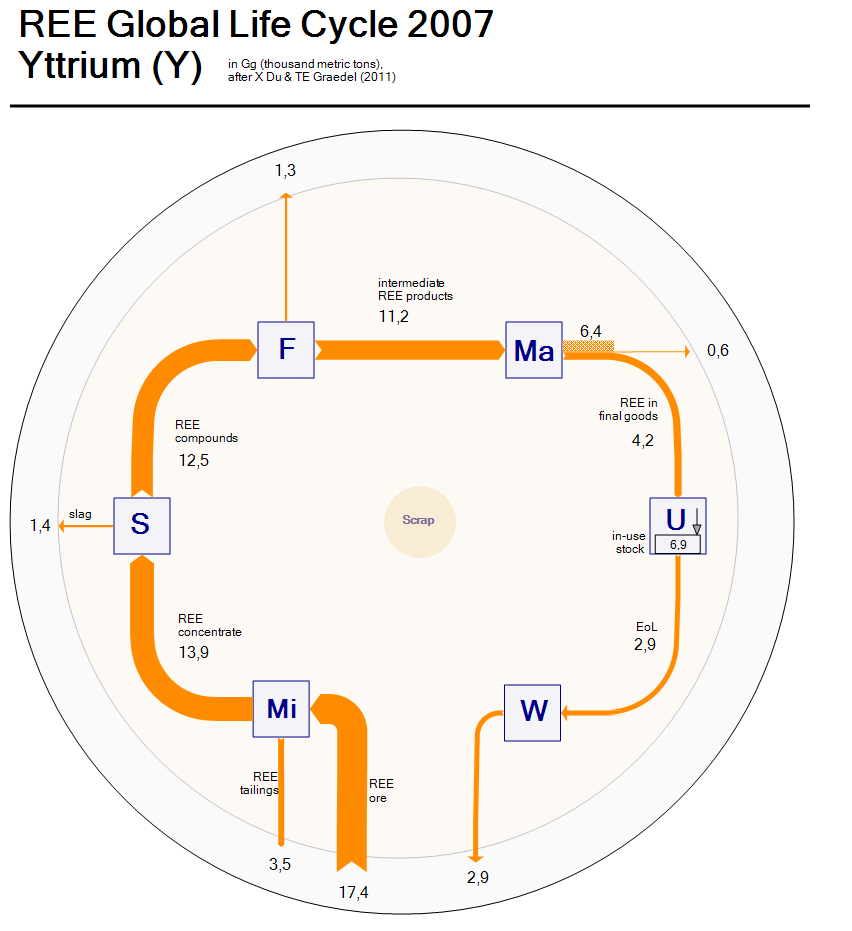
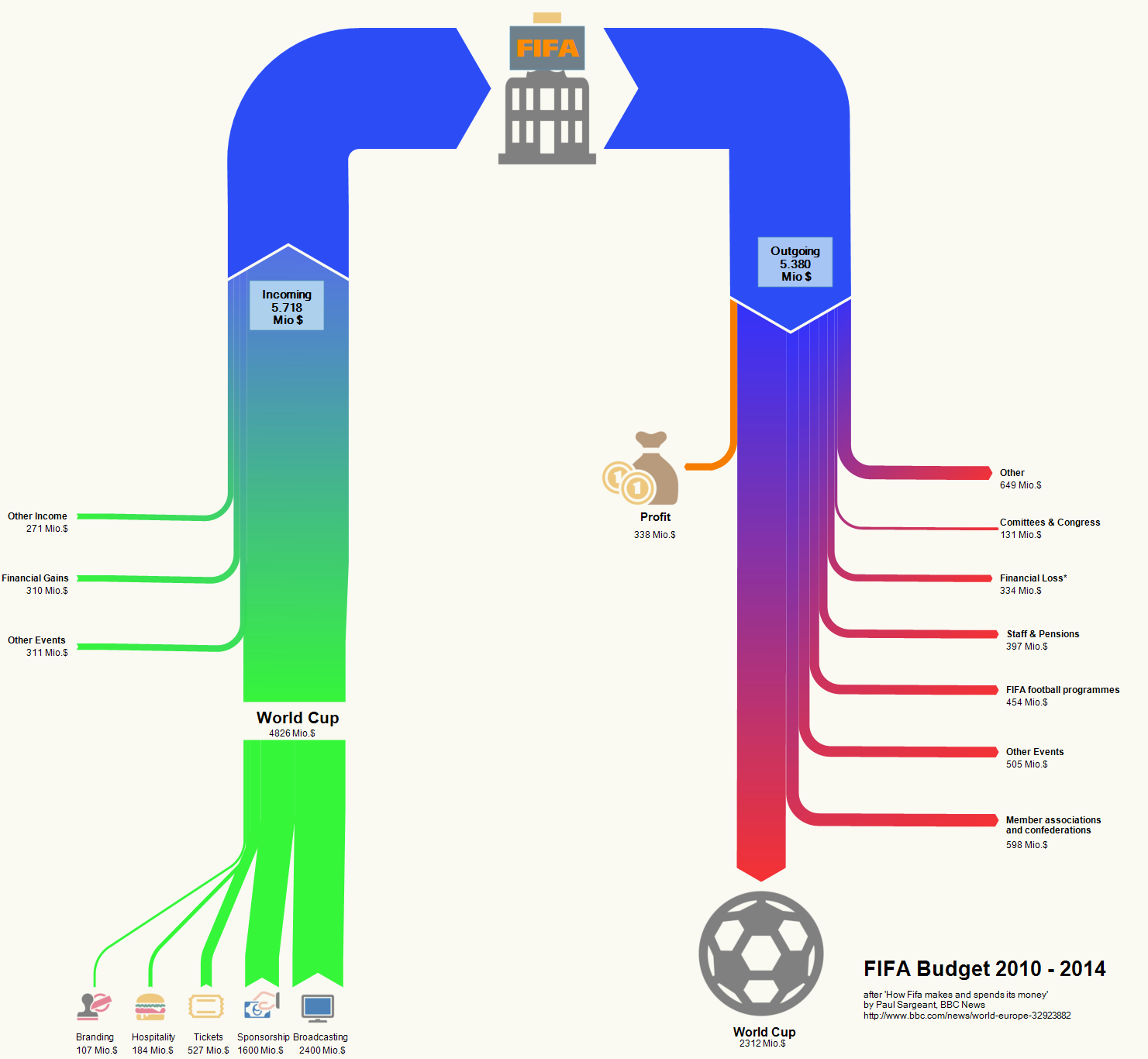
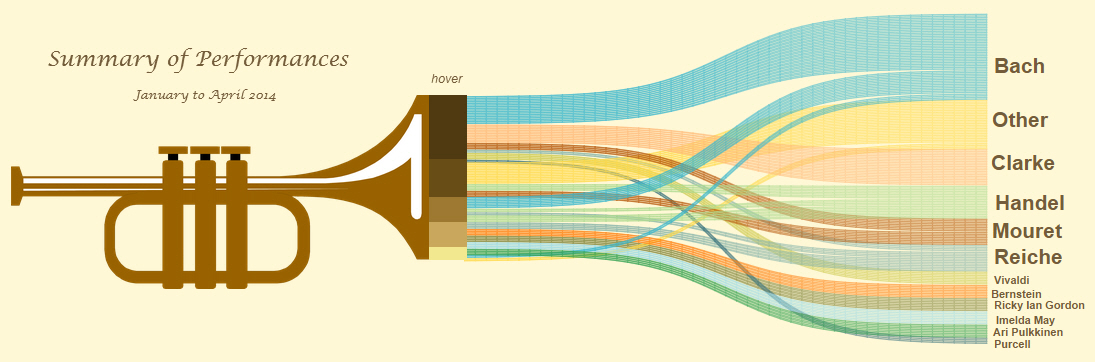
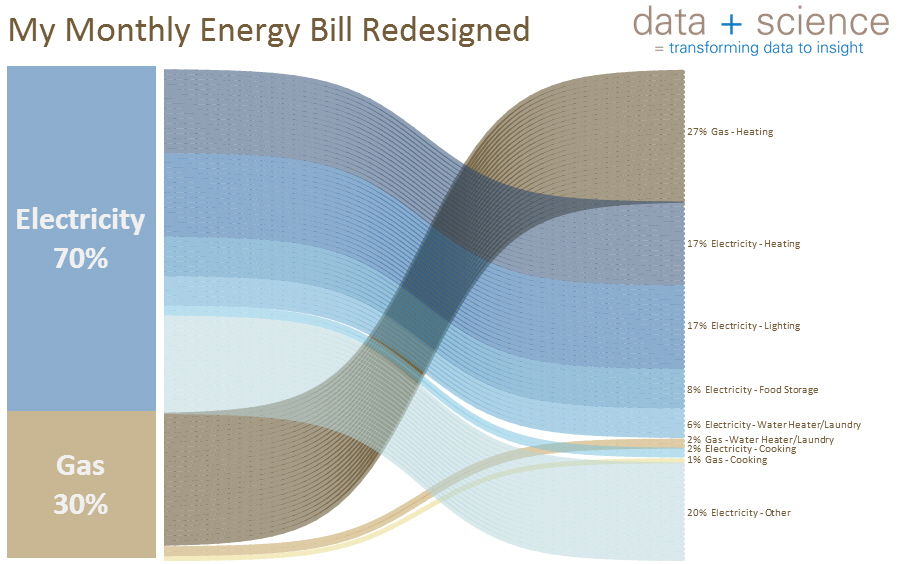
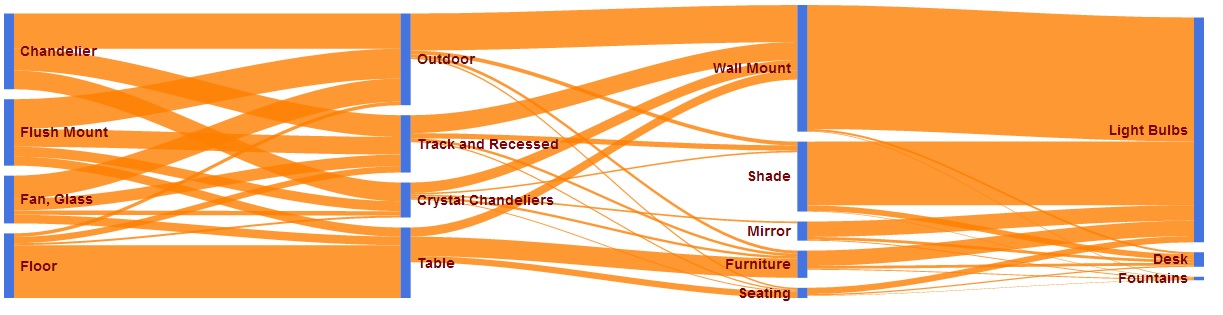
Gabor Doka, developer of SankeyHelper is currently working on SankeyTurtle, the implementation of a simple language for arrow routing in his Excel macro-based diagramming tool SankeyHelper. SankeyTurtle is currently being beta-tested.

The idea of SankeyTurtle code is to give each Sankey flux – each data cell – an accompagnying instruction how to draw the flux exactly in terms of path and geometry. The SankeyTurtle syntax is based on the vintage Logo TurtleGraphics drawing language, where you tell an imaginary turtle with a pen attached to it’s tail commands like “Move Forward” and “Turn Right 90°” and record the trail of the pen.

SankeyTurtle, a scripting language for Sankey Helper, currently being beta-tested

This will definitely an exciting improvement for all users of the SankeyHelper freeware … sorry, Sankeyware.

I’ll keep you posted about the progress and any official release.

Found the following Sankey diagrams in an educational presentation by UNIDO on Cleaner Production (CP).

Sankey diagram from UNIDO presentation on Cleaner Production (CP). Sankey diagram from UNIDO presentation on Cleaner Production (CP). Overlay of the new values on Sankey diagram with old values in grey.

This is actually quite a nice idea to show the improvements resulting from a technical measure. The diagram on the left represents the original situation, while on the right it is seen in grey. The flow diagram for the new situation overlays the “old” diagram. Both are scaled to 1 kg of varnish applied to a workpiece (the green Sankey arrow), so the reductions in input quantity and emissions show the actual savings achieved.

andycrellin posted an inquiry on the board of the Flowing Data, regarding software for drawing so-called source-destintation split diagrams. Nathany answered pointing to the Sankey software list on this blog. Thanks!

Source-destination Sankey diagram created by andycillin, shown in a forum post on FlowingData. http://forums.flowingdata.com/topic/creating-source-destination-diagrams

This is andy’s colorful sample. Quite nice. I especially like the color gradients along the bands, a feature which – to my knowledge – none of the software tools currently supports.

Below is a great example of how to misguide the viewer’s interpretation of data in a Sankey diagram. Found this one on presentation slides somewhere on the web.

A Sankey diagram showing energy losses, but by overemphasizing the arrow heads and deliberate widths of some arrow sections, gives a wrong idea of the values.

The two arrows branching off to the top in a 90° angle do not maintain their magnitudes, which supposedly represent the quantities, and are drawn at a deliberate width. On top of that, the bases of the arrowheads are about two times as wide as the actual arrow width, thus overemphasizing the flow. Look at the 40% thermal losses which look much larger than the 50% useful work to the right side…

I did play around a little bit with this tiny example, and came up with a number of alternative versions.

Alternative version 1: Arrow line widths proportional to quantities for all sectors. Large arrow heads (as in original pic) for all arrows.Alternative version 2: Arrow line widths proportional to quantities for all sectors. Arrow head for smallest arrow only.Alternative version 3: Arrow line widths proportional to quantities for all sectors. Small arrow heads for all arrows, no border line, around arrows.Alternative version 4: Arrow line widths proportional to quantities for all sectors. No spiked arrow heads, no border line.Alternative version 5: Rounded arrows. Small arrow heads for all arrows, no border line. Percentage labels on the arrows rather than with the text label, but no explicit dividers in the horizontal part.Alternative version 6: Arrow line widths proportional to quantities for all sectors. Small arrow heads for all arrows. No border line, but grey dividers on the horizontal part. Percentage labels on the arrows rather than with the text label.Alternative version 7: Arrow line widths proportional to quantities for all sectors. Colored arrows with small arrow heads for all arrows. Percentage labels on the arrows.

Not sure which one is the “best” one, and each has its pros and cons. #1 (hover the mouse pointer over the image to see the number of each alternative version) is very close to the original version. The arrow head size in #3 is more modest. #4 has no explicit spike arrow heads at all. #6 has grey divider lines on most of the horizontal section. I kind of like #7 with color differentiation best, but then again, it is energy that is displayed in all flows.

What do you think? Let me know your favourite or suggestions for improvements in your comment

Following yesterday’s post with the translation of a blog post by Chiqui Esteban from infografistas.com here is the translation of the post “Caudales, erogación… ¿flujo?” of April 5, 2009. Again, I left some words in Spanish in square brackets.

– translation start –

Volume flow, distribution… flux?

A new chapter in the discussion [polémica] about the ‘scientific’ name of the “little arms” graphics ['gráficos de bracitos'].

Xocas came up with the name ‘volume flow’ diagrams ['gráficos de caudales'] and my vote was for ‘distribution diagram’. Other suggestions were thrown in: Xoán G. made reference to Minard and his ‘capacity diagram’ ['gráfico de aforo']. Herminio J. Fernández voted for cosmography diagrams ['cosmografías'] as refered to by Stovall [Infographics by James Glenn Stovall, Allyn&Bacon, Massachussetts, 1997]. Many others voted for ‘flow diagrams’ ['gráficos de flujo'], although Xocas discarded this suggestion because “the term flow diagram normally refers to a very specific type of visualization of process [flows]. It could be used as a generic term, but has interference with another model”.

Now, there is a new player in our conversation. It is Mario Tascón, who also believes that the correct denomination is ‘flow diagrams’. His justification:
“According to Harris (Information Graphics) and Bruce Robertson (How to make Charts and Diagrams) these graphics are called flow diagrams, and are of the type in the same category which are used as decision diagrams in informatics [computer science]. The latter are more in fashion now [Por motivos de modas], but the former have always [sic!] existed (a historic example is the one of Napoleons troops)”.

Suggestions are welcome in the comments.

– translation end –

I hope I got it more or less correct. It is not easy to find the right translation for the sometimes subtle differences between the terms. For those of you who can read Spanish, please check out the original post and the full discussion thread on Xocas’ blog.

The post is decorated with this beautiful Sankey diagram.

Sankey diagram (or distribution diagram) showing earnings and spendings of the Spanish state in 2008. From Pùblico newspaper created by Jorge Doneiger and Álvaro Valiño, shown on infografistas.com blog.

It shows the main earnings and spendings of Spain in 2008 and was produced by Jorge Doneiger and Álvaro Valiño for the daily newspaper Publico in 2007. Values are in million Euros. Flows are not always to scale as for as I can see: the ‘impuestos especiales’ in dark black and the ‘deuda pública’ (at the bottom on the right side) are examples.

The top part shows the sources of funding, the bottom part the beneficiary sectors. The fact that the stacked width in the middle is wider than that of the funds distributed suggests that the Spanish state is actually piling up its money, but probably this has to do either with the list of recipients not being complete, or with earnings received in 2008 but not distributed in the same year.

The hand with the coin supports Chiqui Esteban’s vote for naming it a ‘distribution diagram’. Toss a coin in the coffee dispenser and wait for your coffee to be poured… errh, did we have ‘dispenser diagram’ already? ;-)

I save the ‘best of comments’ and my reasoning why I still call them Sankey diagrams for another time…

Note (Aug 19): A case of DYRF, do your research first! I just detected that Chiqui himself has an English version of his article here. So, now you got the choice between two versions!

Chiqui Esteban who runs the Spanish blog infografistas.com had two posts back in March/April about a discussion he had with his colleague Xocas on how to name Sankey diagrams. Or, to be more precise: how a certain type of diagram that is more and more used in infographics should be named correctly.

They are absolutely funny, so I am trying to give you a translation of these two blog posts. This is part 1 for a post from March 17 titled “Gráficos de erogación”. I left some words in Spanish and my comments in square brackets.

Sankey diagram (or distribution diagram) showing distribution of .3 bn federal aid for NYC. From New York Times, shown in infografistas.com blog.

– translation start –

Distribution Graphics

A couple of months ago, Xocas and I discussed via GTalk what the name, or what should be the name of the diagrams with the little arms ['gráficos de bracitos']. As it turned out, the winner name was volume flow graphics ['gráfico de caudales'].

Today, we decided to withdraw our proposal and we are going to call them ‘distribution graphics’ instead ['gráficos de erogación'].

This is because of the coffee. The coffee machine of my new employer www.lainformacion.com (click the link, we are already up running), shows the message ‘distributing’ ['erogando'] while you wait for your cup to be filled. Looking in the RAE [note: Real Academia Española], the verb ‘erogar’ is defined as:

(Del lat. erogāre).

1. tr. Distribuir, repartir bienes o caudales. [distribute, share the goods or funds]
2. tr. Méx. y Ven. Gastar el dinero. [México and Venezuela: spend money]

This definition is spot on. So we shouldn’t continue to call them ‘little arms’ ['de bracitos'], ‘tubing’ ['de tubería'], ‘squid’ ['de pulpo'], ‘tree-roots’ ['raíces'] or whatever diagrams any more. But don’t say that we didn’t work hard in finding the correct nomenclature. As we have to do. So Tufte will… ['A Tuftear'].

– translation end –

The accompanying Sankey diagram apparently is from the New York Times and shows how 21.4 billion $ in federal aid for NYC after 9/11 were distributed (hey! there you are, a ‘distribution diagram’ ;-) ). Funny enough, the caption says: “The figure above is an attempt to bring sources of funds together and show how they add up (sic!) to $ 21.3 billion”.

So what is distribution for one, is “adding up” from another perspective.

Part 2, the translation of “Caudales, erogación… ¿flujo?” and a summary of the comments to follow.

Note (Aug 19): A case of DYRF, do your research first! I just detected that Chiqui himself has an English version of his article here. So, now you got the choice between two versions!

I was very delighted to see a blog post on visual reports on Arup’s fieldofactivity.com blog with an embedded video that has Sankey diagrams.

Arup Australasia’s Digital Innovation Team is working on interactive reporting technologies. They say that “… not everyone reads technical reports, so this is the beginning of what’s next – visual reports.”

Check out the video, it is interesting, and watch out for the Sankey diagram seconds 0:15 to 0:21

What we see is a Sankey diagram unfolding in an animated sequence. One step further would be animated Sankey diagrams, like the research project I posted about that came up with a Java/Quicktime animation on energy flows, and this Sankey animatedGIF on CO2 and energy from 1990 to 2015.

Any other animated Sankey diagrams out there…?

Chris the VisioGuy recently came up with Radial Sankey Diagrams. Although he didn’t seem to be sure if there is a “need for radially-oriented Sankey diagrams”, the commentators of his post immediately came up with ideas: use for rotating or radiating processes, cigarette rolling, recursive industrial processes, reinvestments, and so on… even stellar nuclear reactions were mentioned.

This is the ‘Everything Radial’ Circular Sankey Diagram

“Everything Radial” Circular Sankey Diagram by Chris Roth (Visio Guy). Shown on his blog at http://www.visguy.com/2009/05/08/radial-sankey-diagrams/

… and this is the ‘Tangential Fly-off’ Circular Sankey Diagram

“Tangential Fly-off” Circular Sankey Diagram by Chris Roth (Visio Guy). Shown on his blog at http://www.visguy.com/2009/05/08/radial-sankey-diagrams/

One concern seems to be that the proportional arrow magnitude doesn’t work that well, since the human eye perceives the arrow area rather than thickness in such a circular Sankey diagram.

Thanks VisisoGuy for this contribution to the big basket of Sankey diagrams