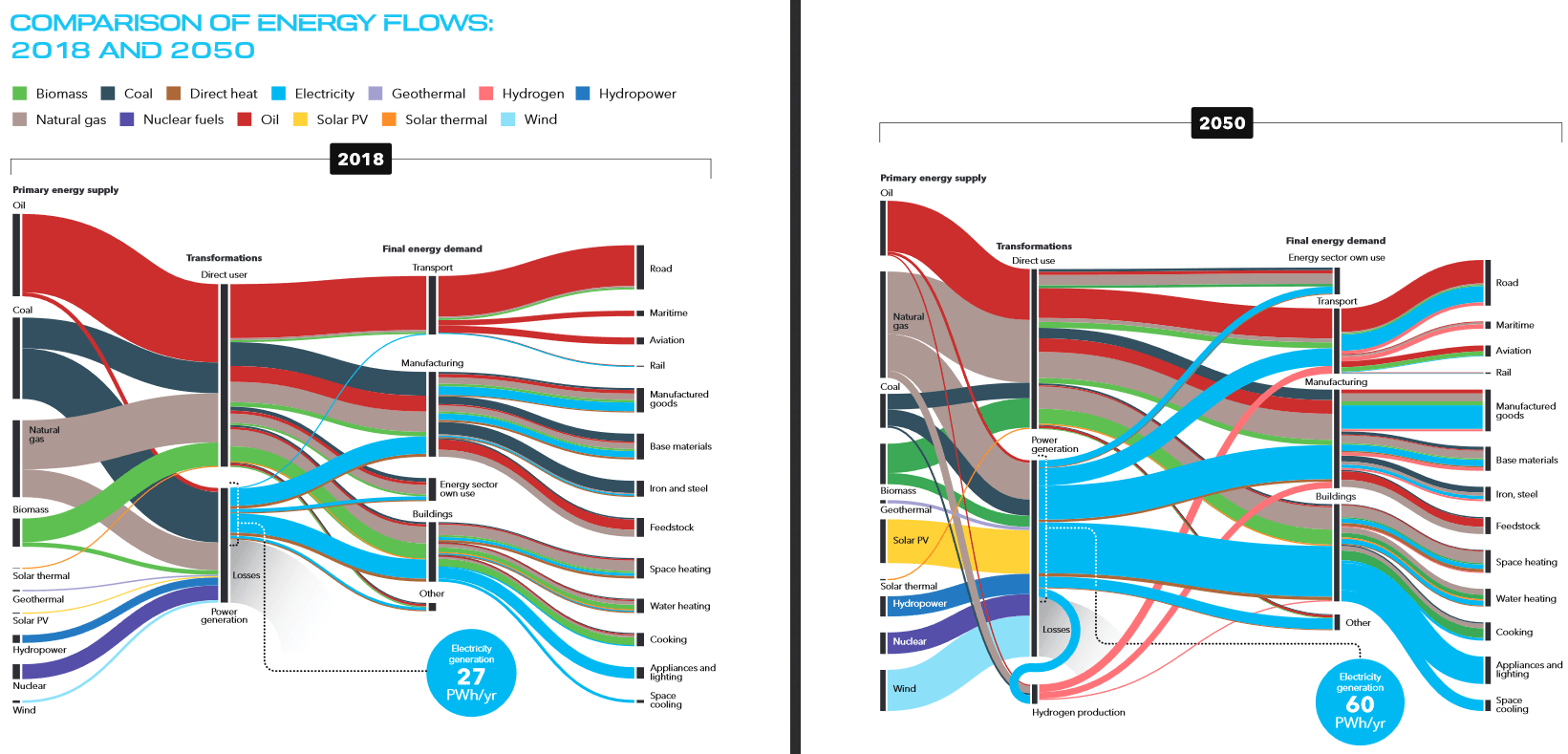
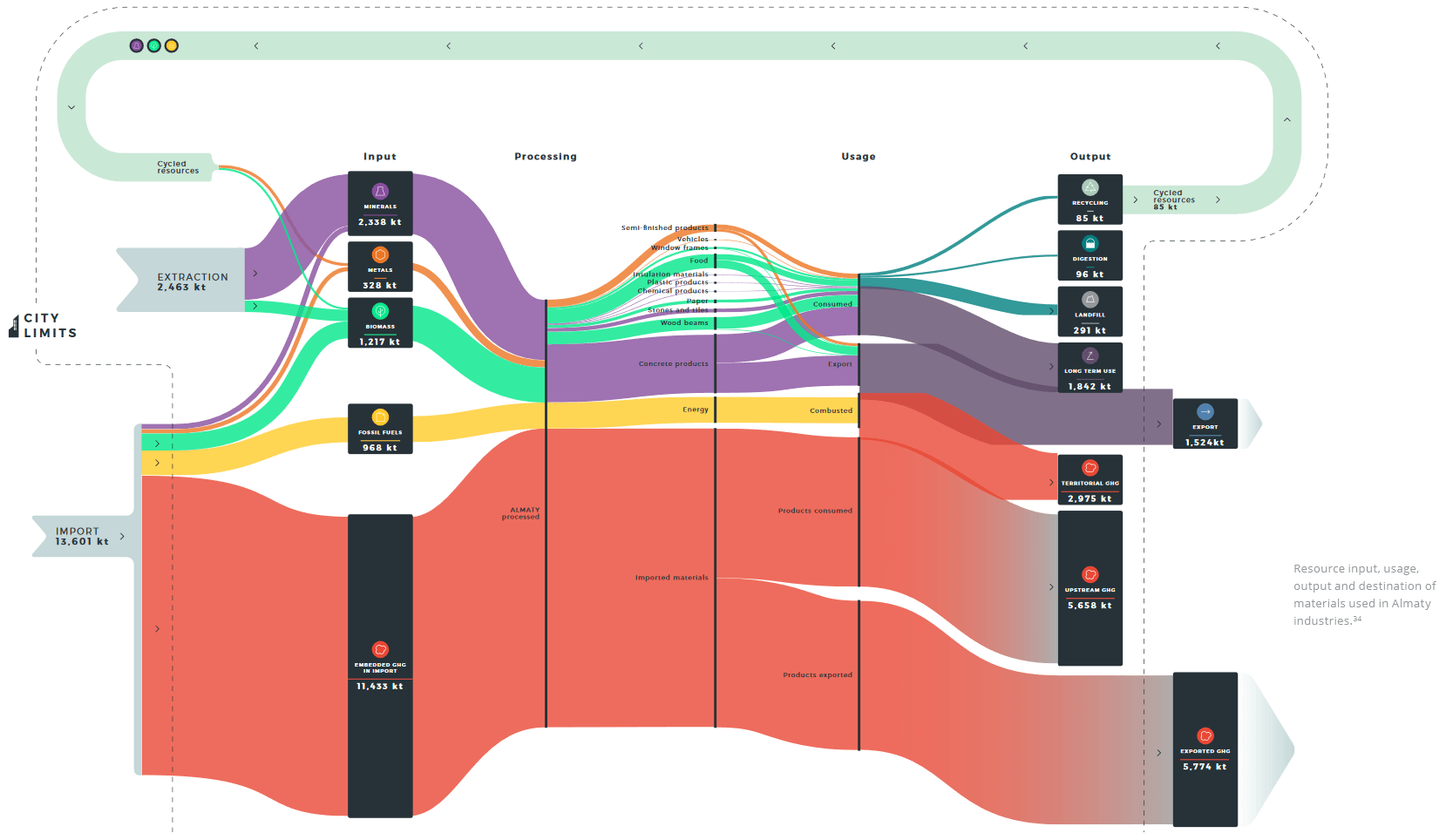
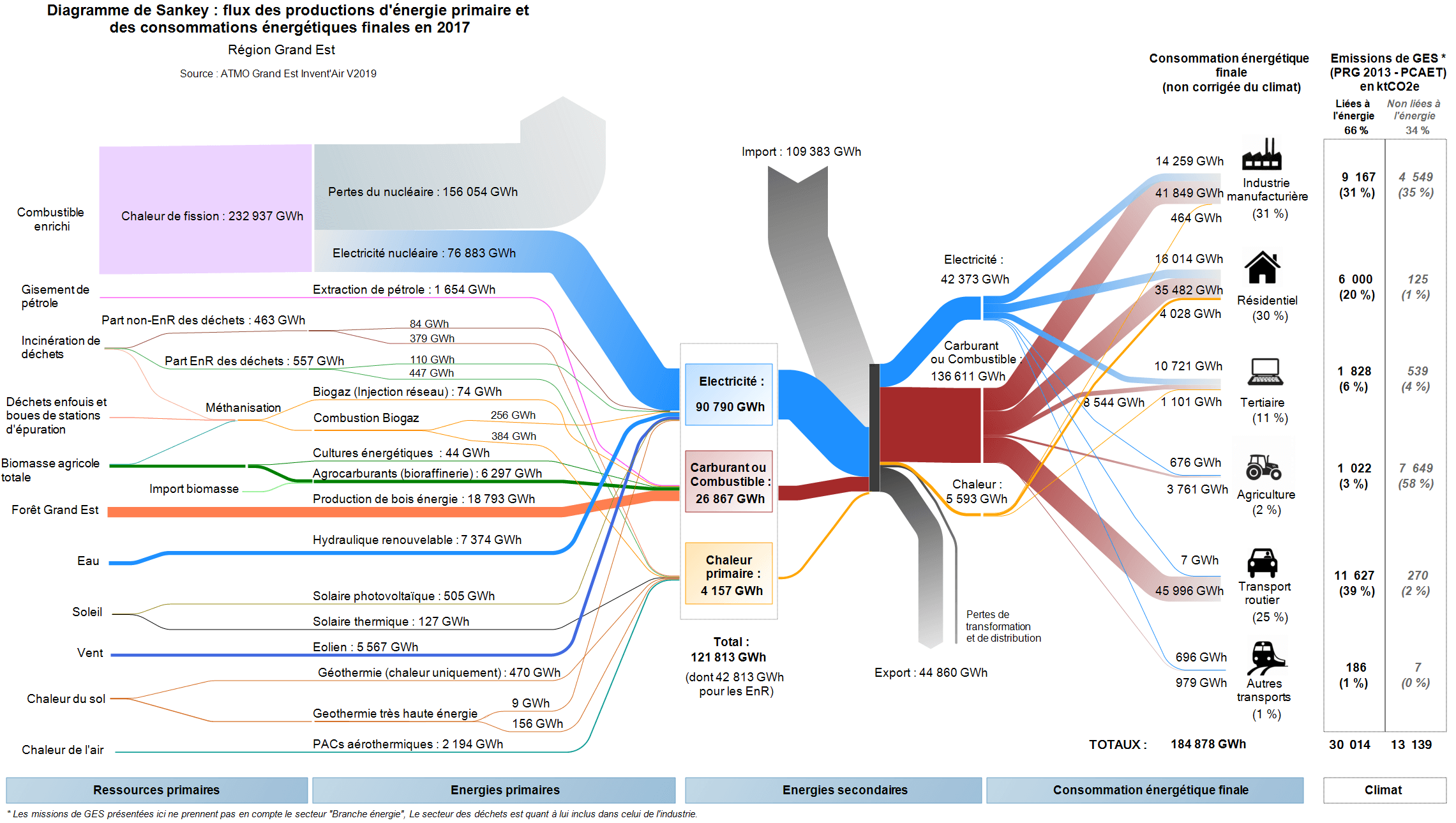
One type of Sankey diagram layout seems to get popular recently. A representation of national energy flows of a country with the energy carriers on the left side (source), and the consumption sectors on the right side (sink). The Sankey flows in between show how energy from these sources are consumed and in which sector. Wasted energy is shown, and the overall energy (in)efficient use of primary energy is made clear with such a Sankey diagram.

I just discovered the energy flow diagram for Spain for 2006 on Joan Vila’s blog.

Sankey diagram showing the energy flows for Spain in 2006. Posted by Joan Vila on http://blocdejoanvila.blogspot.com

Unfortunately I don’t speak Catalán (well, I learned that “blog” is “bloc” in Catalán!), and the image quality isn’t very good. You can see nuclear, natural gas, coal (”carbó”) and crude oil (”petroll”), as well as hydro an wind (the two green lines) on the left side. The top box on the right side that takes the big red Sankey arrow for losses from electricity generation (”pérdues”). The others are the use sectors transport, industry, and domestic / services / agriculture. Vila calculates an efficiency of 38,2% for the electric power generation.

Joan advocates Sankey diagrams for visualizing and being able to better understand the issue. He says, that you won’t understand many things about what’s going on, if you don’t study this [kind of] diagram (”No entendrem moltes coses sobre el que passa si no estudiem aquest diagrama.”).

Check out simiular diagrams for Japan, Scotland, Ireland, Canada, United States.

Just back from a short late summer holiday, enjoying a few “Sankey-free” days at the coast. To get going again I am presenting a Sankey diagram you might have seen already. It is Gabor Doka’s sample diagram for his ‘Sankey Helper’ application.

Sankey diagram created with Sankey Helper 2.1 (by G.Doka)

The tool comes as a Microsoft Excel workbook, with a number of macros and a toolbar that allows to create shapes and assignments from the data sheet to these shapes. Of course, graphical layout capacities of this helper tool is limited, however, simple diagrams can be drawn easily once you understand how to handle it.

Sankey Helper 2.1 is freeware - err, sorry! - “Sankeyware”. You must sent the author a Sankey diagram you created, but otherwise there is no cost. Nice idea! Download Sankey Helper from Gabor Doka’s website.

This Sankey diagram shows COD (chemical oxygen demand) in a waste water treatment plant that handles both municipal waste water as well as effluents from a chemical plant.

It was generated using the software package STOAT, which allows for dynamic simulation of wastewater treatment plants. Image with kind permission of Berlin-based EnviaTec GmbH.

CSB loads in a waste water treatment plant. Sankey diagram created with STOAT model. Image courtesy of EnviaTec GmbH (http://www.enviatec.de)

The Sankey diagram does not show any flow quantities explicitly, and the values seem to be clustered into five or six fixed arrow magnitudes. The flows have a flat arrow base, and a rounded arrow head, which is uncommon, but still let’s you determine the flow direction. Process clipart icons overlay the nodes, where flows branch off or merge.

I have added the STOAT model to the list of software tools with Sankey drawing capabilities.

A presentation titled ‘La eficiencia energética: una opción estratégica para la empresa y para el país’ (’Energy Efficiency - a strategic option for companies and for the country’) by Pedro Maldonado of the Energy Research Program (Programa de Estudos e Investigación de Energía) at Universidad de Chile features a Sankey diagram as an important tool in energy auditing.

Sample Sankey diagram on energy efficiency (taken from presentation by Pedro Maldonado, La eficiencia energética: una opción estratégica para la empresa y para el país, Dec 2006)

The diagram shows exemplary losses (pérdidas) in heat generation, heat transmission and the use of heat. Use of heat is broken down into drying, pasteurization, evaporation, etc. The main message of the author: “The energy we purchase is not what we ultimately use as energy for our productive processes”.

This article on “Conceptualizing the built environment as a social-ecological system” by Sebastian Moffatt (CONSENSUS Institute) and Niklaus Kohler (University of Karlsruhe) published in Building Research & Information, Volume 36, Issue 3 May 2008 , pages 248-268 has an exciting Sankey diagram in the section ‘Current perspectives, promising methods, missing pieces’ (scroll down about half way).

The authors explain Sankey diagrams as an instrument of Material Flow Analysis (MFA)

“Sankey (directional flow) diagrams are often used to summarize the MFA visually as an entire connected and balanced system. In a Sankey diagram the material flows begin with inputs from nature, then flow into intermediary processes (any infrastructure used for processing, converting, storing, or regulating), and then into the various end use(s). After use, flows may be reconverted by infrastructure systems for reuse or recycling. Ultimately, all flows are directed to a category of output (waste products emitted into air, into water bodies or into landfills; long-term storage; export). The balanced accounting thus tracks every flow from source to sink.”

A five stage Sankey diagram sample for water being used in a household. (Original diagram appears in: Moffat/Kohler. Conceptualizing the built environment as a social-ecological system

The Sankey diagram shown in this article is for an resource efficient house, planned or built in New Delhi (India). It shows the water flows through five groups of processes (sources, converters, demands, re-converters, and sinks). The authors call it a “five-partition metabolic profile”, and suggest that it can be done not only for a single house, but “for the built environment at any scale, from parcel to urban region”.

The unit for the quantities given is not indicated, but I presume the water flows are in litres.

When reproducing the Sankey diagram I tried to make it a little more clearer by changing the order of the (invisible) nodes, thus avoiding crossing flows.

A great Sankey diagram is available in the Charts&Maps section on the website of the World Resources Institute (WRI), “an environmental think tank that goes beyond research”.

It shows the sectors from which greenhouse gases (GHGs) are released (such as energy generation, land use change, agriculture) and the end use areas or activities, through which CO2, methane and others gases are relased.

Data is for 2000, the diagram was published in 2005. A very well done Sankey diagram indeed, and highly educational.

Unfortunately a request for showing this Sankey diagram here on the blog was not granted by WRI, and an attempt to purchase the publication right (OK, it was not an attempt, it was a price inquiry only) was in vain.

I have to respect WRI’s copyright policies, so you have to click here to view the World GHG Sankey diagram, or download the large version PDF.

They also did a Sankey diagram on U.S. Greenhouse Gas Emissions, available on their website and as a PDF. Enjoy!

A reminiscence to the days when Sankey diagrams were drawn in black&white by hand and labeled with a typewriter. The three Sankey diagrams below from a 1990 article on “Energy conservation in the mechanical forest industries” by FAO (Food and Agriculture Organization of the United Nations, FAO Forestry Paper No. 93, Rome 1990) illustrates energy use in sawn timber, plywood and particleboard production.

Sankey diagram for heat and electricity consumption in sawmilling (from: Energy conservation in the mechanical forest industries. FAO FORESTRY PAPER 93. Rome, 1990)Sankey diagram for heat and electricity consumption in plywood production (from: Energy conservation in the mechanical forest industries. FAO FORESTRY PAPER 93. Rome, 1990)Sankey diagram for heat and electricity consumption in particleboard production (from: Energy conservation in the mechanical forest industries. FAO FORESTRY PAPER 93. Rome, 1990)

The article explains that

“Although the diagrams are of an approximate nature they do serve to identify the relationship that each major energy consuming centre has with each other and also readily identifies the prime energy users to which particular attention should be paid in any conservation effort.

In all three product manufacturing processes heating is by far the largest user of energy, representing some 82-87 percent of the total energy requirement in the manufacture of sawntimber, plywood and particleboard, with drying accounting for approximately 87 percent, 61 percent and 62 percent respectively.”

Use of Sankey diagrams with kind permission of FAO

The Council on Cempetitieveness has just called on the presidential candidates to come up with a national energy plan, believing that future economic growth and security of the United States depends on energy efficiency across the U.S. economy, sustainable energy solutions, and development of new technologies.

The new president might want to ask John Ziagos to advise him on energy issues. Ziagos is with the Energy & Environment Directorate at Lawrence Livermore National Laboratories, and an expert for energy scenarios. For me as a Sankey aficionado he is simply the “man behind the Sankey diagrams at LLNL”.

John Ziagos (photo by Jacqueline McBride/LLNL)

LLNL has been publishing energy flow diagrams for the U.S. over the last few years. In his public presentations (link1 - 2.9 MB, link2 - 4.8 MB) Ziagos impressively shows that even when implementing fuel cell technology for all vehicles, switching completely from coal and natural gas to renewable energy sources to generate the nation’s electricity, and building 270 new nuclear power plants … even then it would not be possible to stabilize U.S. carbon emissions between now and 2050. “If we want to move toward a carbonless future, no single technology will do – everything counts.” Ziagos says.

I am reprodrucing two energy flow diagrams for the U.S. from John’s presentations below. The first is for 1976, the second a 2025 projection.

Energy flow diagram for the U.S. for 1976. Taken from: John P. Ziagos and Gene Berry. Visualizing Future Exergy Flows for the U.S. & World. Presentation held June 12/13, 2007 at SMU, Dallas TXEnergy flow diagram projection for the U.S. for 2025. Taken from: John P. Ziagos and Gene Berry. Visualizing Future Exergy Flows for the U.S. & World. Presentation held June 12/13, 2007 at SMU, Dallas TX

While overall energy produced will rise from 72 Quads in 1976 to an estimated 133 Quads p.a. in 2025 [Note: 1 Quad(rillion) equal to 10E15 BTU, or 1.055 × 10E18 joules (1.055 exajoules or EJ) in SI units.], the ratio of useful energy to rejected energy gets worse.