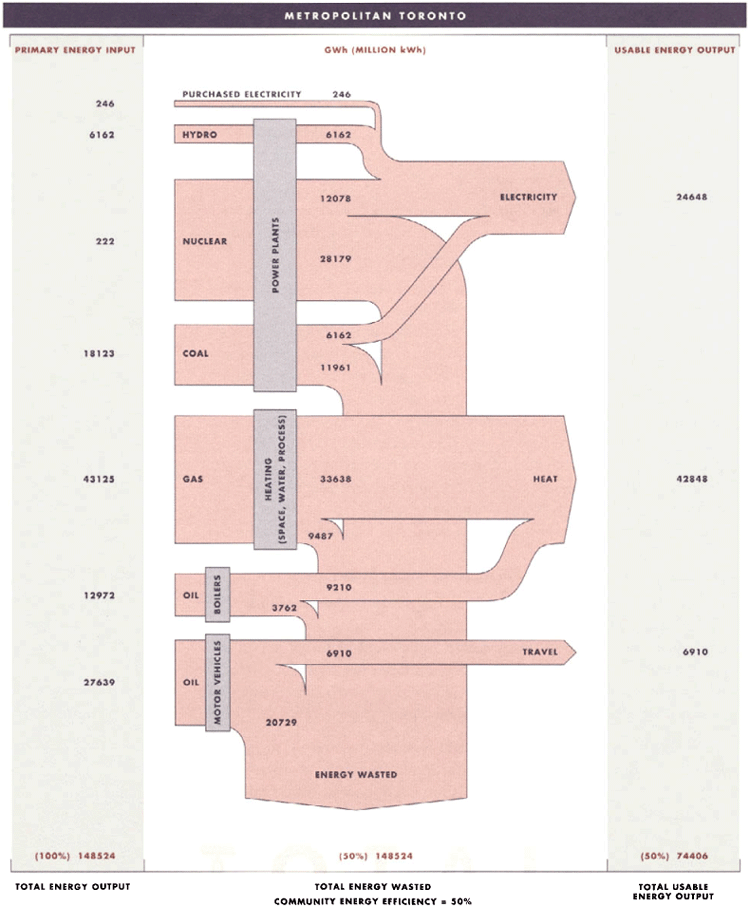
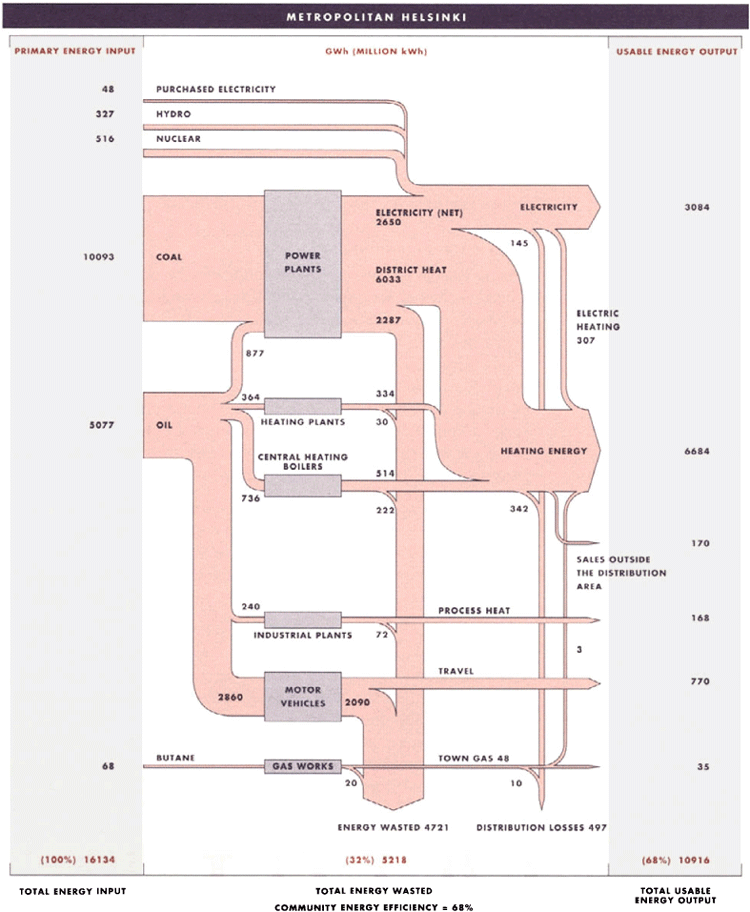
I have posted several Sankey diagrams depicting the energy flows of countries. At least California and West Virginia have published state energy flow Sankey diagrams. I was quite excited to discover the two metropolitan energy flow Sankey diagrams shown below in this publication. They are for Toronto and Helsinki and show energy flows in 1988 in these communities.

Metropolitan Toronto energy flow Sankey diagram for 1988. Source http://www.idrc.ca/openebooks/448-2/Metropolitan Helsinki energy flow Sankey diagram for 1988. Source http://www.idrc.ca/openebooks/448-2/

The two diagrams show energy consumption and use in Toronto (above) and Helsinki (below). Even though the absolute figures in GWh are given, one shouldn’t directly compare them. A per capita basis would be fairer (Toronto had a population of 2.5 mio in 2006, more than 5 mio. in the metro area, while Helsinki had 580.000 inhabitants in 2008 in the city, 1.3 mio in the greater Helsinki area — Toronto is today 4.5 times larger than Helsinki). Both are “cold-climate municipalities”.

The publication calculates a ‘community energy efficiency’ of 50% for Toronto and 68% for Helsinki. “A comparison of the two municipalities reveals that Helsinki significantly improved its efficiency by using the waste heat that is produced by local coal power plants to warm 90% of the buildings and homes in Helsinki. Further analysis has demonstrated that Helsinki’s energy system was able to achieve its overall level of 68% efficiency because the city’s compact land-use pattern made investments in energy-saving infrastructure, such as district heating and public transit, economically viable.”

Does anybody know other metropolitan energy flow studies? I am aware of research activities in the field of urban material flow accounts or urban metabolism (e.g. Lisbon) but have to check whether they show Sankey diagrams in their publications.

In early November I was pointed to an image on the Innovation Strategy Canada website [the website itself is not accessible any more] by a reader of this blog. Peter asked whether I know of any Sankey diagrams for financial flows, like they are shown in the one below.

The diagram visualizes the sources of R&D funding, and the institutions receiveing this funds. Data is from Statistics Canada for 2006 and shown in Mio (supposedly) Canadian Dollars.

Distribution of R&D Funding in Canada for 2006. Taken from http://www.innovationstrategy.gc.ca/gol/innovation/site.nsf/en/in05364.html on November 2008. Website not available any more.

While there are only four different arrow widths to show the financial flows, the interesting thing is that the sums of funds from each source and received by each beneficiary are shown as cylinders (database symbols, tanks, …).

I quickly did several versions of the diagram, but was not too happy with the results. The flow quantities are OK, but as it turns out, it is difficult to see the volume of the cylinder, supposedly to scale with the sums. This information is redundant anyway, since the width of the joined arrows at their base or at their head is exactly the sum that is supposedly to be shown by the cylinder volume.

Here is one version of my Sankey diagram for R&D funding in Canada for 2006 based on the original image. I decided to make the boxes in different sizes (the problem remains the same: can one immediately grasp the area of each box)

Major Flows of R&D Funding in Canada. Based on an original chart shown on Distribution of R&D Funding in Canada for 2006. Taken from http://www.innovationstrategy.gc.ca

Your comments are welcomed. Is there a better way to display the sums?

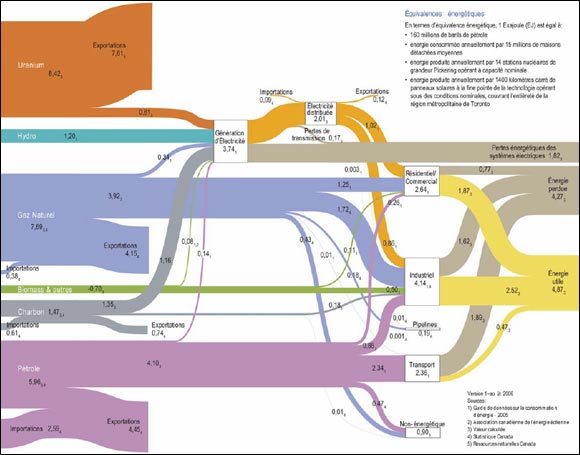
Statistics Canada in its “Report on Energy Supply-demand in Canada” for 2005 shows two Sankey diagram in the annex (HTML version of the two Sankey diagrams). They show the energy flows for Canada 2005 and 2004 in Petajoules per year.

Energy Flows for Canada for 2005. Published in

I have featured similarly structured diagram for other countries here before: Japan, Scotland, Ireland, and the United States.

Out of 21380 PJ of total energy produced in Canada and imported, some 9641 PJ (45%) are exported, while 11739 PJ (55%) are national consumption. If you have the impression that the proportions are not 45:55, you are right, they are more like 39:61! From a graphical perspective this Sankey has more peculiarities worth a mention: the magnitude of the Sankey arrow changes and just before the arrow head they become narrower. The flows labeled “Steam” and “Adjustments” seem to have been added at a later stage as they don’t merge into the other arrow. Steam is represented on the production side as well as in the breakdown of energy carriers with a small, but not unsignificant width, however the quanity is given as zero.

Environment Canada in 2001 published a Pollution Prevention Planning Handbook, a 153 page guidance manual on processes and techniques for pollution prevention (full PDF here – large!).

In section B-7 of the handbook materials accounting and mass balances are presented as one technique. The text states that

materials accounting and materials mass balances can be presented in a tabular or diagrammatic format. A Sankey diagram provides one useful method for representing a picture of material flows and balances.

and a sample diagram is shown.

Sample Sankey Diagram from Pollution Prevention Handbook by Environment Canada

Although not all quantities of the individual flows are shown, and there is no reference to the unit used, I think this is a fine example of using Sankey diagrams. The mass imbalance at the first process “Presse” (at the very left) is clearly visible. From the neighboring downstream processes you can see that at least 2105 units (to “Trémie”) and 738 units (to “Évaporation”) leave the process, that has inputs of only 2616 units. The diagram was made with S.Draw.