This Sankey diagram shows COD (chemical oxygen demand) in a waste water treatment plant that handles both municipal waste water as well as effluents from a chemical plant.

It was generated using the software package STOAT, which allows for dynamic simulation of wastewater treatment plants. Image with kind permission of Berlin-based EnviaTec GmbH.

CSB loads in a waste water treatment plant. Sankey diagram created with STOAT model. Image courtesy of EnviaTec GmbH (http://www.enviatec.de)

The Sankey diagram does not show any flow quantities explicitly, and the values seem to be clustered into five or six fixed arrow magnitudes. The flows have a flat arrow base, and a rounded arrow head, which is uncommon, but still let’s you determine the flow direction. Process clipart icons overlay the nodes, where flows branch off or merge.

I have added the STOAT model to the list of software tools with Sankey drawing capabilities.

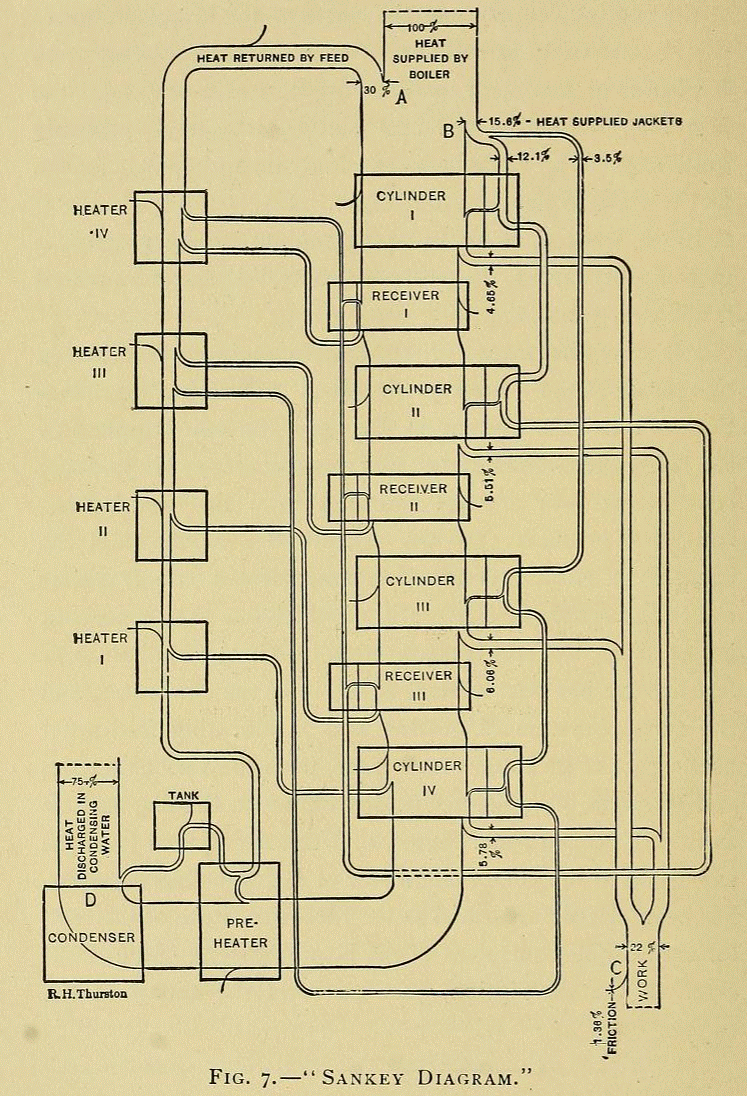
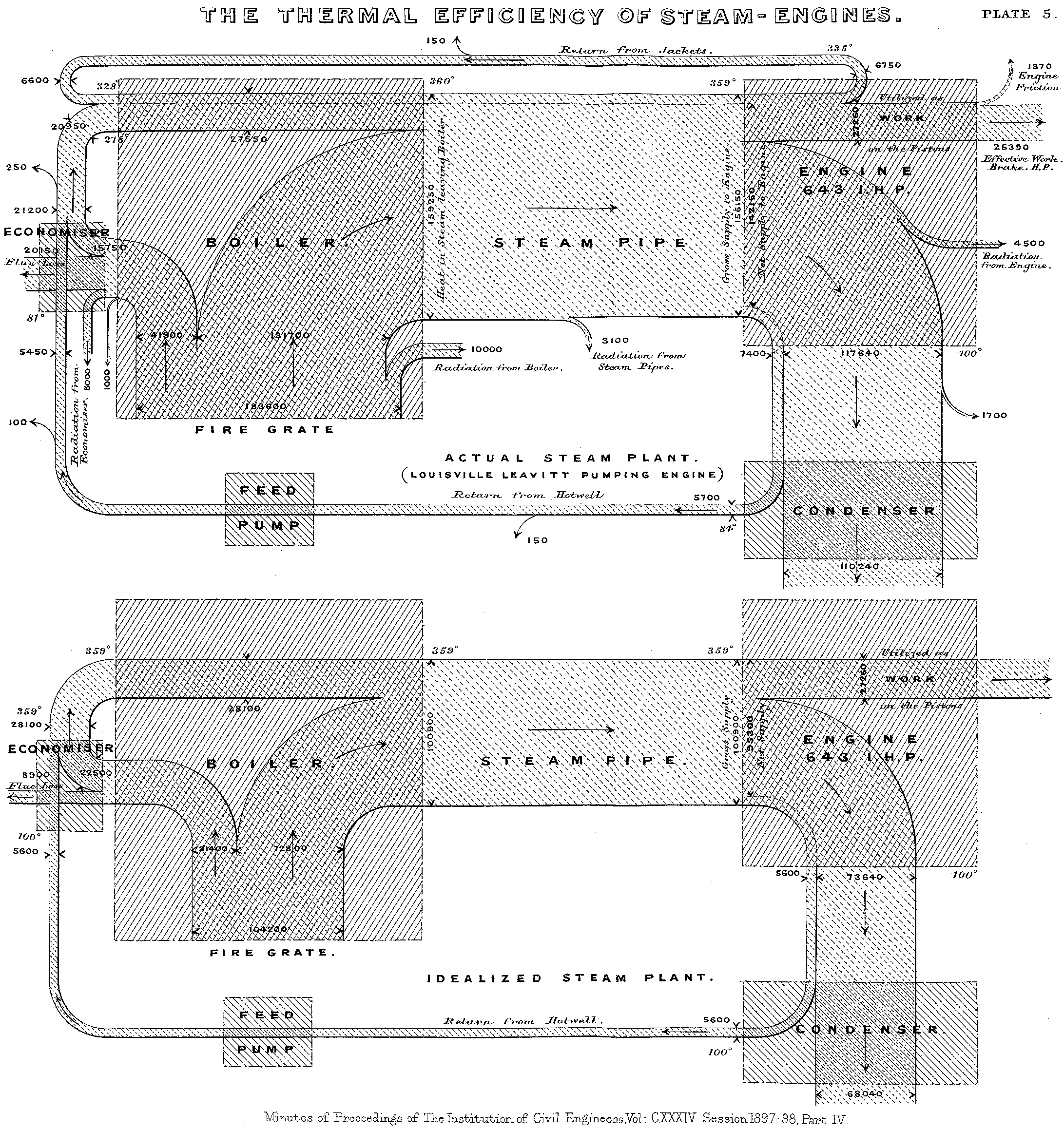
A scan of one of the first - if not THE first ever - published Sankey diagrams has now been added to the Dutch and German Wikipedia articles. Actually I had always wanted to get hold of a digital version of this this energy efficiency diagram published by Captain Henry R. Sankey in 1898 in the Minutes of Proceedings of The Institution of Civil Engineers. Vol. CXXXIV, Session 1897-98. Part IV.

First Sankey diagram published 1898 in JIE (Source: Wiki Commons)

Click here to see the image in original size.

Sankey used this novel type of diagram to represent energy flows and energy losses in a steam engine, comparing it to an ideal steam engine.

I do acknowledge that the term ‘Sankey diagram’ is not as common as a ‘pie chart’, and that many people don’t know it, even if they have a rough idea of this type of diagram. One might just call a Sankey diagram a ‘mass flow diagrams’ or ‘flow chart’, or ‘energy efficiency chart’. Or a ‘heat loss diagram’, as I have seen it once.

So, then: what is Sankey?

In times where “to google” is synonymously used for “to search”, a visit to Google will give you a first idea. I also recommend a query at Googlism, a site that has some very subtle answers to the above question (I very much like “Sankey is 7 or 7″ and “Sankey is aboard” ;) )

But seriously: Sankey is originally both a name of a locality in England, as well as a family name. Famous Sankey’s include Ira D. Sankey, a gospel singer and composer (1840-1908) and magician Jay Sankey. And of course the lesser known Captain H.R. Sankey, the first to publish an energy efficiency chart, and the reason why we call Sankey diagrams Sankey diagrams. I will try to aggregate some information on this personality, to honor his invention.