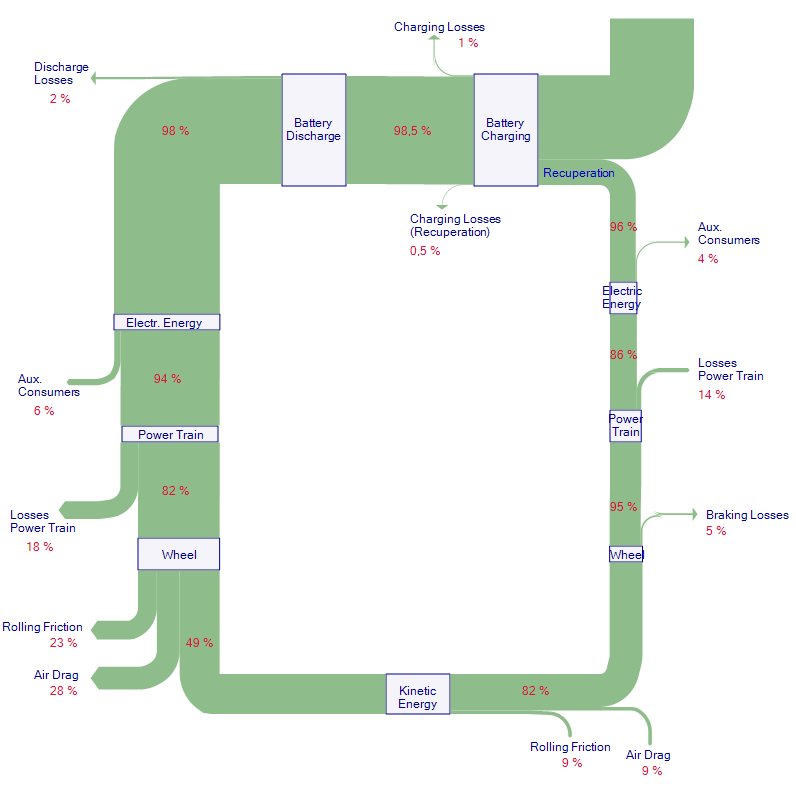
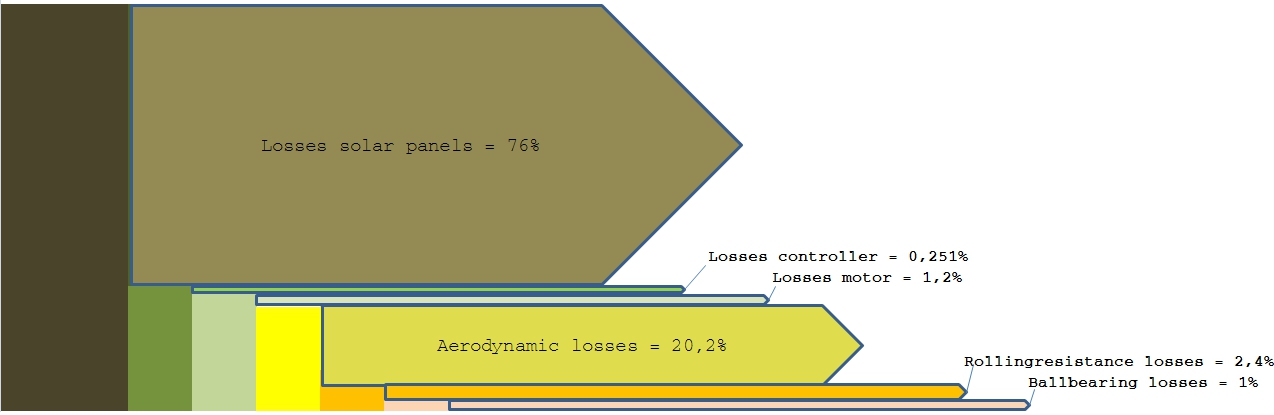
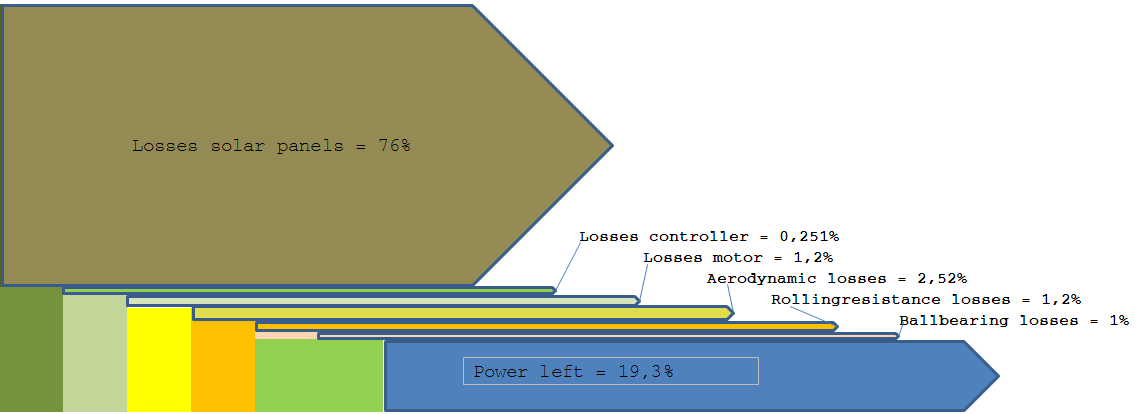
Found these two Sankey diagram on Wikiversity. I think it was somewhere on one of the sub-pages on the small solar vehicle… They show energy losses at the different components of the vehicle, such as at the solar panels or through rolling resistance. Percentage values.

wikiversity_motor1 wikiversity_motor2

These diagrams are made up from rectangles and simple arrows. Only straight arrows, no curves. The blue color of the border of some of the thinner arrows adds a strange effect…

Found the below Sankey diagram in the article ‘Plug-in Electric Vehicle Interactions with a Small Office Building: An Economic Analysis using DER-CAM’ by Ilan Momber et al. from Berkely National Lab published in Proceedings of the 2010 IEEE PES General Meeting, Power Systems Engineering in Challenging Times, 26-29 Jul 2010, Minneapolis MN.

micro_grid_sankey

The Sankey diagram is for illustration only, and consequently shows no numbers. Yellow arrows represent electricity, blue arrows heat. The red Sankey arrows show where losses occur. The article itself is mainly on plug-in vehicles (PEV), that’s why the ‘alternative fuel vehicles’ are emphasized on the right side in the uses section.

The underlying model DER-CAM “solves a commercial building’s microgrid problem of investment and operation optimization given its end-use energy loads, energy tariff structures and fuel prices, as well as an arbitrary list of equipment investment options. … [It] can report a cost, carbon footprint, or combination minimizing equipment choice and (typically hourly) optimal operating schedule for the microgrid, including CHP and renewable sources.”

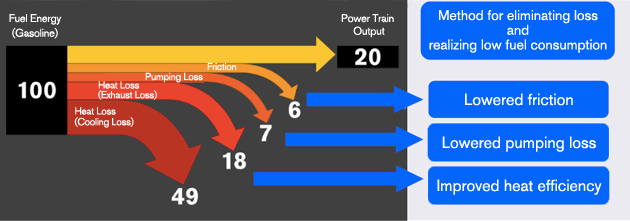
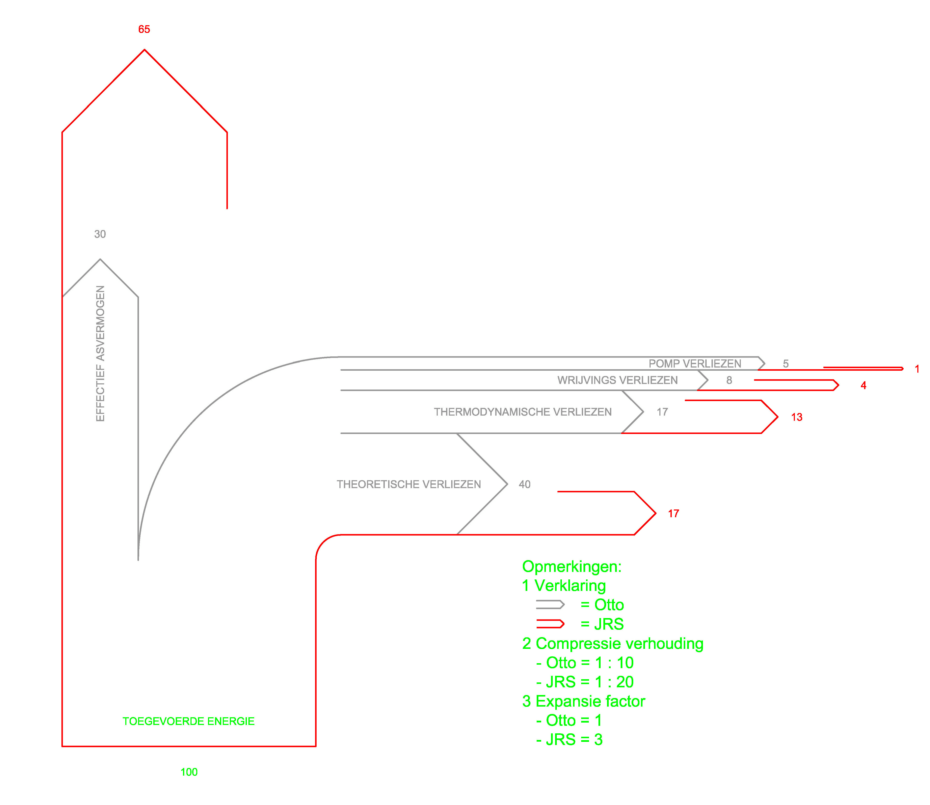
The below Sankey diagram from the JS Systems homepage tries to show the differences between a normal Otto engine and the “JS Motor”. The prototype JS rotation motor, from what I grasp, has different compression and expansion parameters and could prove to be twice as efficient.

jrc_motor_sankey

To show the difference in efficiency, two Sankey diagrams have been superimposed. The diagram with the grey outline is for the Otto engine, the one with the red outline is for the JS engine. The diagram shows energy losses branching off to the right (e.g. thermodynamic losses 17% in a typical Otto engine, 13% only in the JS motor). Useful energy is represented by the flow to the top.

I am not endorsing this motor, nor have I seen it work. But I like the idea of presenting a comparison in one Sankey diagram instead of two separate Sankey diagrams.

Also, please check out this previous blog post on Sankey diagram overlay.

Just returned from a short break … trying to get back into the regular blogging mode again. Here is a quick one from my bookmarks.

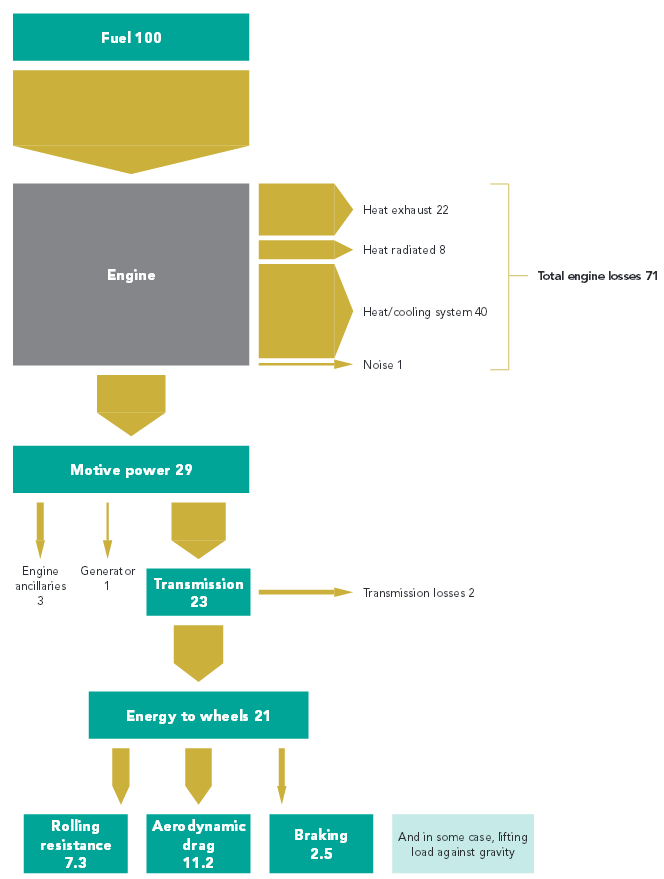
The Sankey diagram below illustrates a research project at Hannover University on energy management of automobiles. Similar to the Sankey diagram shown in this post it shows how total energy from gasoline is used in different components of a car.

geml_sankey

The Sankey diagram is symbolic I assume, still one can see that large portions of the energy are lost in the exhaust gas (“Abgas”) and for motor cooling (“Kühler”). Flow quantities are given in Watt, not sure if that is per hour at a given speed or in idle mode.

The U.S. Department of Energy (DOE) is funding research projects that target the increase of efficiency of car engine.

The Sankey diagram shown in this post on the Green Car Congress blog visualizes that only 25% (green arrow) of the energy from combustion is used as “effective power” for mobility and accessories, while 40% of the energy is lost in exhaust gas.

energy_split_combustion_engine

Projects are being carried out at John Deere, Caterpillar, Detroit Diesel and Mack Trucks, to name just a few.

“Seven of the twelve projects focus on advanced combustion technology with a heavy focus on HCCI (Homogeneous Charge Compression Ignition). There is also an diesel-compressed-air hybrid truck powertrain under development. The remaining projects deal with technologies to convert waste heat from engines to electrical or mechanical energy.”

The inefficient energy use of car engines and other vehicles are the main reason for the transport sector being (next to energy generation and transmission) the sector where most energy is being lost (see this post).