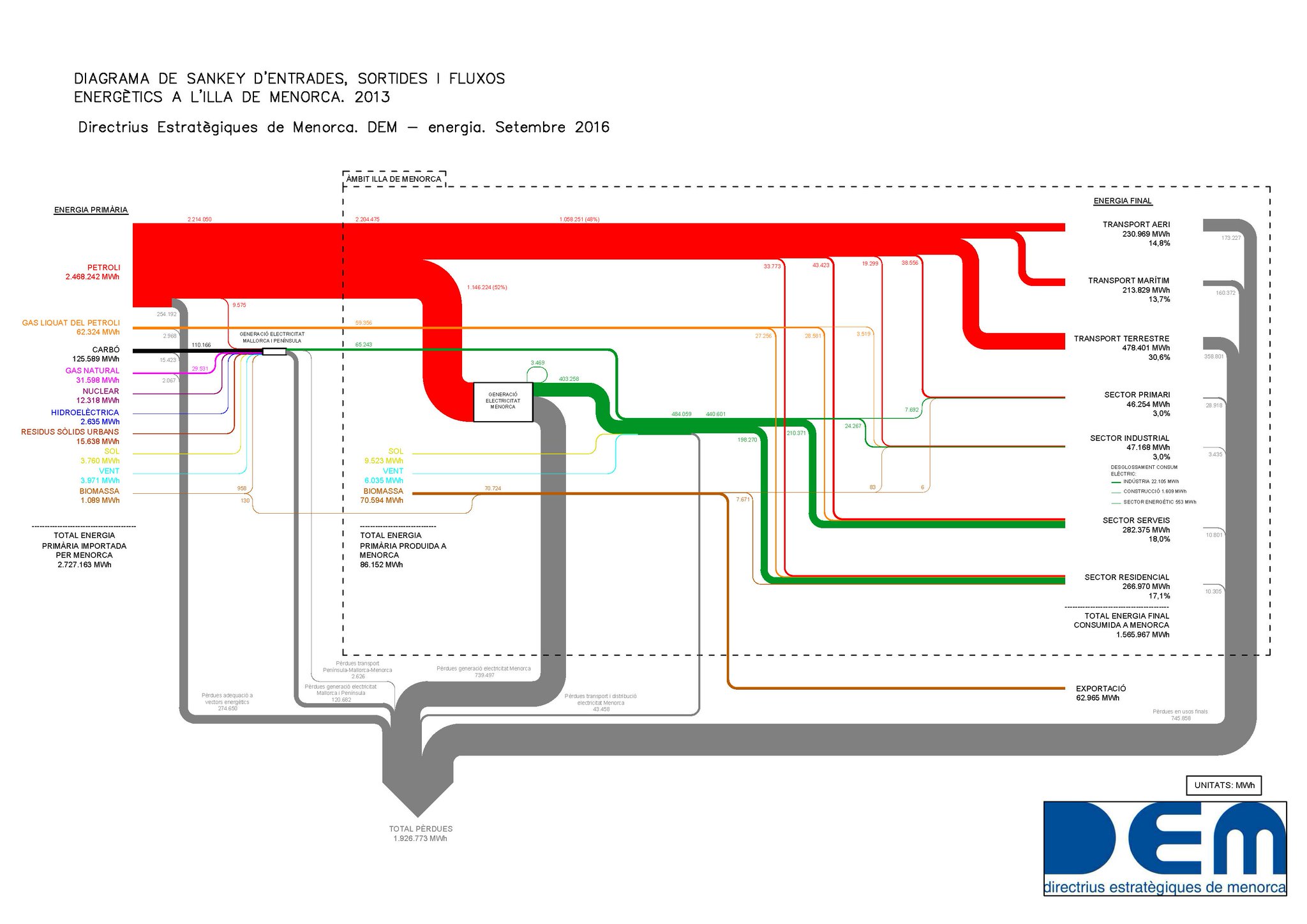
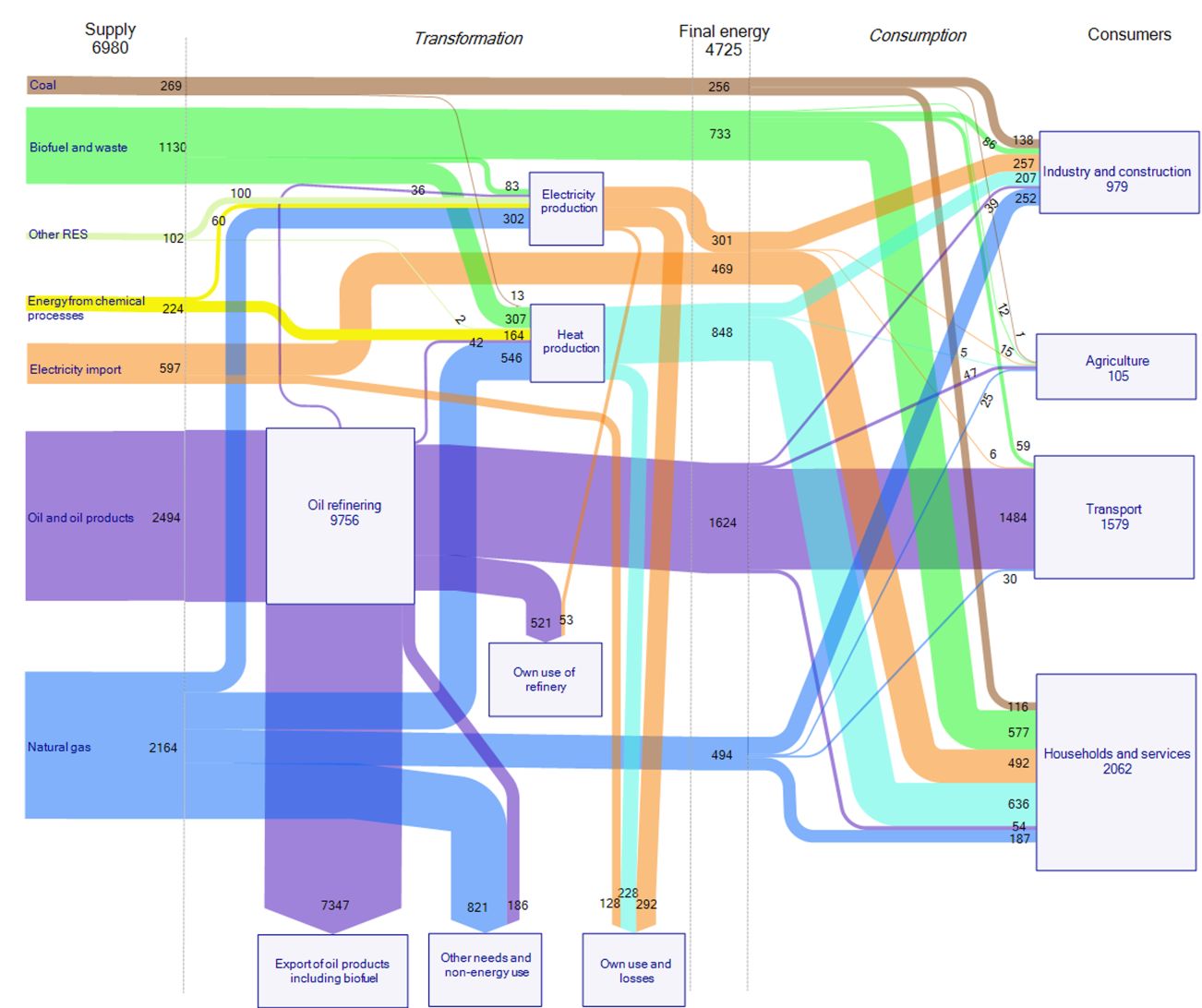
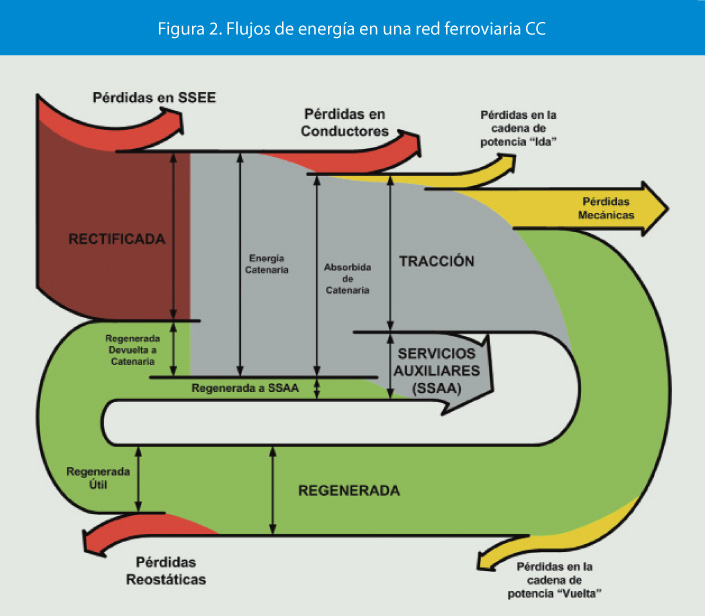
Found this all pink Sankey diagram on Oliver Seely’s webpage. And since copying is actually encouraged and welcomed, I’ll reproduce this 1970 U.S. energy flow Sankey diagram for all readers of this blog. Happy Easter Holidays!
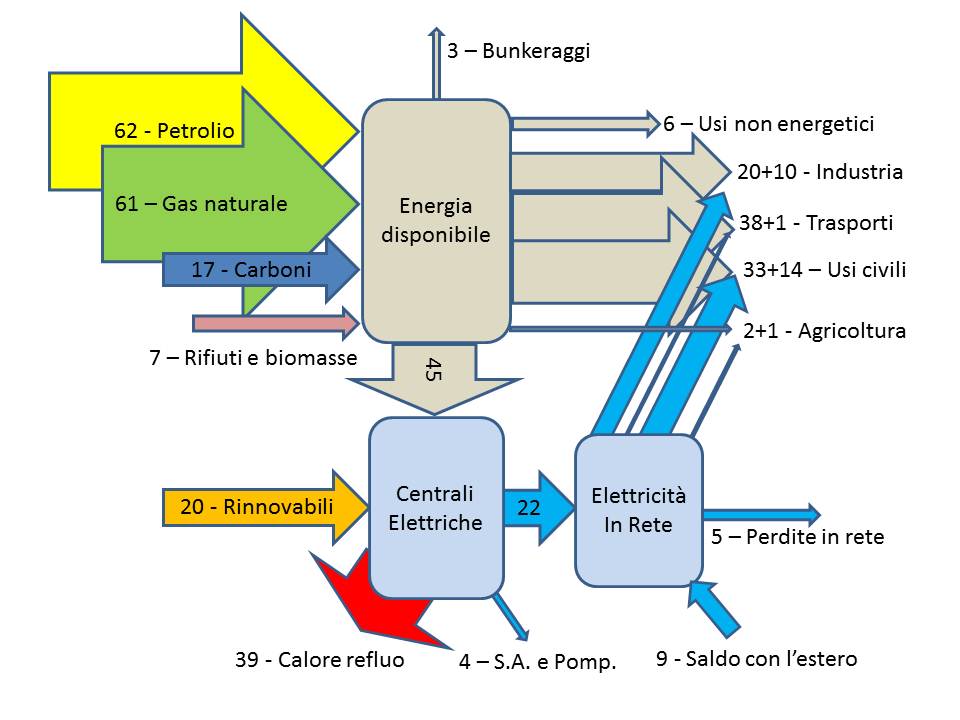
Motiva is a state owned limited company from Finland offering energy efficiency analysis and energy audit for companies. Motiva also developed audit guidelines and models, and engages in training and authorisation of the energy auditors.
In their energy audit reports, they always include a Sankey diagram in the very first chapter. Here is an example:
Other consulting companies, such as Pöyry (not sure how to pronounce this) haven taken on their approach and are also producing Motiva style Sankey diagrams.
Both Sankey diagrams designed in PowerPoint. Not bad at all, but probably quite a time-consuming task.
A reader of the blog alerted me about a new report that contains Sankey diagrams for the United Kingdom’s 2007 and 2050 energy flows. Thanks, Neil!
The report is about heat demand and CHP (Building a roadmap for heat. 2050 scenarios and heat delivery in the UK) and was prepared by University of Surrey and Imperial College for the Combined Heat and Power Association (CHPA). On p. 18 it has the following Sankey diagram. I have shown a similar diagram for the UK in this post.
Data is from the Digest of UK Energy Statistics. All flows are in millions of tonnes of oil equivalent (MTOE). Primary energy demand in 2007 was 237 MTOE.
The second Sankey diagram presented (on page 23) is a scenario for 2050. It was calculated using the MARKAL model.
One must read all the assumptions made for the model to be able to interpret it, but you can see immediately that the “energy system in 2050 is signifcantly altered under the common assumptions presented in all-electricity scenarios. In particular, final energy consumption in 2050 will be reduced by 46% against 2007 figures under the assumptions used in the CCC 80% CO2 reduction scenario”.
I invite you to read chapters 3.3. and 3.4 of the report to better understand the 2050 Sankey diagram. Note that the overall primary energy demand is significantly lower, but power generation almost doubles compared to the current situation. Losses from oil refineries are omitted in this scenario due to lack of data.
A great Sankey diagram by the research group made up from researchers from ICEPT (Imperial Centre for Energy Policy and Technology) and Centre for Environmental Strategy at the University of Surrey.
An interesting project summary can be found on the energyech.at pages, “a virtual exhibition and information platform” by the Federal Ministry of Traffic, Innovation and Technology (Department for Energy and Environmental Technologies) and the Austrian Energy Agency”. A PV-diesel hybrid energy generation system was installed at mountain refuge “Klagenfurter Hütte” in southern Austria to secure power supply and reduce dependency on diesel fuel, and to bring down energy costs.
The Sankey diagram shows the energy flows over a 30-month test period from July 1993 to December 1995. Out of the 4981 kWh of energy, 2124 kWh were produced by the diesel engine, while 2857 kWh came from the 18 sqm installed PV modules. A storage battery is installed, and the diesel generator can be used to recharge it if there is no sunshine. The overall efficiency of the system was 61% over the testing period, but could be higher after the energy measuring equipment (consuming 499 kWh itself) was removed after the testing period.
The Sankey diagram shows actually measured values in kWh. It has a top-to-bottom orientation. Diesel is on the left side, the photovoltaic system on the right. Losses branch out horizontally. The battery is the blue box labeled “DC-Ges.” in the middle.
A presentation from 2005 on the French energy flows included the Sankey diagram below (I prefer not to name the author or the link to the original source, in order not to embarass anybody).
This Sankey diagram is pretty much messed up, and definitely a candidate for the “Worst Sankey Diagram Contest” that has already been called for. It took me a few seconds to understand that the flows dangling vertically below the blue arrow are actually a breakdown of the 177 mtep consommation finale. Vraiment … j’ai vu mieux que ça!
This is more or less how I would do it. Less colors, a breakdown of the blue flow into the five consumption sectors.
End-of-year cleanup of my bookmarks and saved diagrams. There are more goodies, and enough in stock for a couple of posts next year…
Below are three image sections of a Sankey diagram showing Swedish energy flows in 2007. These were published on p. 54/55 in the report ‘Energy in Sweden 2008′ by Swedish Energy Agency (Energimyndigheten). Numbers are in TWh, source for the diagram was Statistics Sweden data.
The first diagram (which is the left part of the diagram) shows the total 624 TWh energy supplied and the energy sources. The second one is the breakdown of energy produced by sectors, and also shows the losses in energy conversion. The third on is a different breakdown of the 404 TWh by energy carrier.
Nothing more to add. They are simple, clean, beautiful.
The Mountain State saw the annual Governor’s Energy Summit in Roanoke on Dec 9, 2009. West Virginia relies heavily on coal, and is a net energy exporter to other U.S. states.
The energy flow Sankey diagram below (created by Marshall University for WV Energy Division) was presented at last year’s energy summit, and is available along with the other presentations here.
Figures are for 2006 in trillion BTU. Energy carriers used in WV are displayed as flows entering from the left. Domestic energy sources are in orange, while imported supplies are in sand color. Overall energy in 2006 was 4,384 trillion BTU. The state exported 81% of the energy (blue) and consumed 19% within (836 trillion BTU). A breakdown of doemstic consumption by sectors is shown in pink.
This Sankey diagram looks nice, but violates the basic rule for Sankey diagrams: flows have to be to scale among each other. The magnitude of the stacked orange arrows (representing 4100 trillion BTU West Virginia production) should be 14.5 times larger than that of the sand color flow (representing 283.86 trillion BTU), however it is only about 9 times larger, overemphasizing external supply (or underrepresenting domestic energy supply).
Or, compare the two arrows fro “crude oil” (10.14) and “natural gas” (230.12). The latter should have 23 times the width of the other… The blue arrow for “international raw coal” (392) looks approximately as wide as that of the blue “natural gas” (106). The scale might still be somehow OK for the base of the arrow, but as the arrow becomes thinner towards the head, the 4:1 ratio is definitely not supported any more.
I have posted several Sankey diagrams depicting the energy flows of countries. At least California and West Virginia have published state energy flow Sankey diagrams. I was quite excited to discover the two metropolitan energy flow Sankey diagrams shown below in this publication. They are for Toronto and Helsinki and show energy flows in 1988 in these communities.
The two diagrams show energy consumption and use in Toronto (above) and Helsinki (below). Even though the absolute figures in GWh are given, one shouldn’t directly compare them. A per capita basis would be fairer (Toronto had a population of 2.5 mio in 2006, more than 5 mio. in the metro area, while Helsinki had 580.000 inhabitants in 2008 in the city, 1.3 mio in the greater Helsinki area — Toronto is today 4.5 times larger than Helsinki). Both are “cold-climate municipalities”.
The publication calculates a ‘community energy efficiency’ of 50% for Toronto and 68% for Helsinki. “A comparison of the two municipalities reveals that Helsinki significantly improved its efficiency by using the waste heat that is produced by local coal power plants to warm 90% of the buildings and homes in Helsinki. Further analysis has demonstrated that Helsinki’s energy system was able to achieve its overall level of 68% efficiency because the city’s compact land-use pattern made investments in energy-saving infrastructure, such as district heating and public transit, economically viable.”
Does anybody know other metropolitan energy flow studies? I am aware of research activities in the field of urban material flow accounts or urban metabolism (e.g. Lisbon) but have to check whether they show Sankey diagrams in their publications.


RSS-Feed Entries