Some of you might have noticed that I tend to get somewhat excited when I discover Sankey diagrams in other languages.

Here is one I dug out on this webpage of the Tsuji Labs at Osaka University in Japan, and it has the honor to be the first one presented on this blog in Japanese!

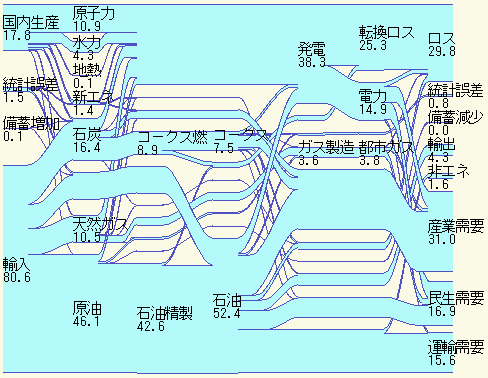
Japan Energy Flow 1993

The diagram shows the “energy flows” (エネルギーフロー) as relative values for the year 1993 only. On the left side we can see that more than 80% of the energy consumed in Japan were produced from imported fuels (輸入), while only 17.8% came from domestic production (国内生産). The quantities are broken down into the different types of fuels, such as crude oil (原油, 46,1%) , natural gas (天然ガス, 10,5%) or hard coal (石炭, 16,4%). The right side of the diagram shows the consumption sectors, with industry (31%), residential (16,9%) and transport (15,6%).

Losses are at 29% which seems relatively low, if you compare to similar Sankey diagrams from the U.S. But then I am not sure if they accounted for the losses in the same way for this diagram.

A section from a picture shown on the website of Tsuji Labs at Osaka University.

There are these two other similar Sankey diagram thumbnails on that site, and my guess is that they represent different energy scenarios, considering renewable energy sources, as an option to reduce dependency from imports. Maybe someone who can read and understand more Japanese than I do wants to comment?
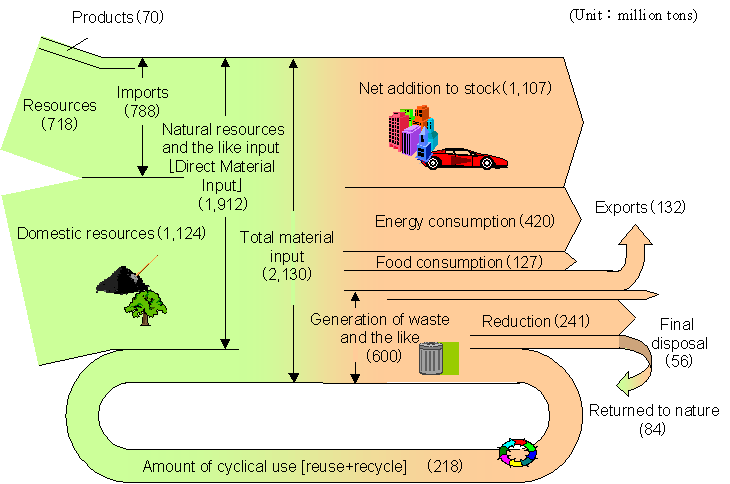
The below Sankey diagram of the ‘Material Flows of Japan in the FY 2000′ has been published by the Japanese Ministry of Environment (環境大臣) and has been reproduced in a number of publications and presentations (sample PPT). Similar charts, representing the inputs into the Japanese economy and the outputs are available for subsequent years.

Material Flows in Japan in FY 2000)

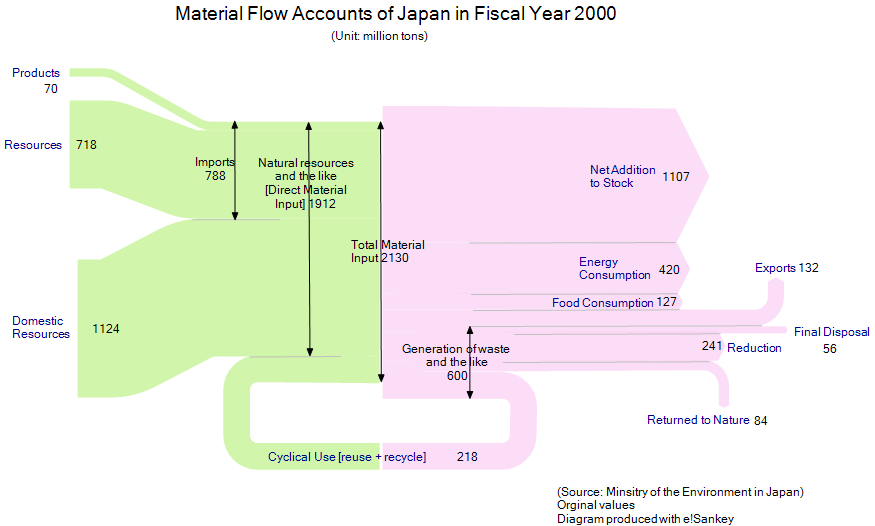
When I copied the values of the Sankey diagram and re-designed it (see pic 1 below), it quickly became obvious that the inputs (2130 Mio. tons) don’t match the Outputs (2386 Mio. tons). After some research I finally detected the reason for the mismatch in a footnote to the diagram in a press release by the ministry. It said that, “due to intake of moisture, etc., total output shall be larger than total material input.” This footnote might have been dropped unintentionally when using the diagram in other publications. I wouldn’t really call this “lying” (as the title of the post implies), but maybe negligence. I wonder if anyboy doubted the numbers when looking at the diagram?

In the second diagram below I adjusted this difference of 256 Mio. tons on the input side.

Material Flow Accounts of Japan in Fiscal Year 2000. Sankey diagram drawn after publication by Ministry of Environment in Japan. Original values show unbalanced input and output.Material Flow Accounts of Japan in Fiscal Year 2000. Sankey diagram drawn after publication by Ministry of Environment in Japan. Unaccounted flows have been added to the diagram to balance input and output.

Another rather surprising thing in this Sankey diagram is the fact that the domestic food consumption within Japan (127 Mio. tons/year in 2000) was almost as high as the total quantity of material being exported (132 Mio. tons). Taking into account, for example, the number of cars being exported from Japan, and their weight, this sounds a little unlikely. However, I think that many of the produced goods might be hidden in the “Net Addition to Stock”.

And for the readers who study Japanese … Sankey diagram : サンキーダイアグラム