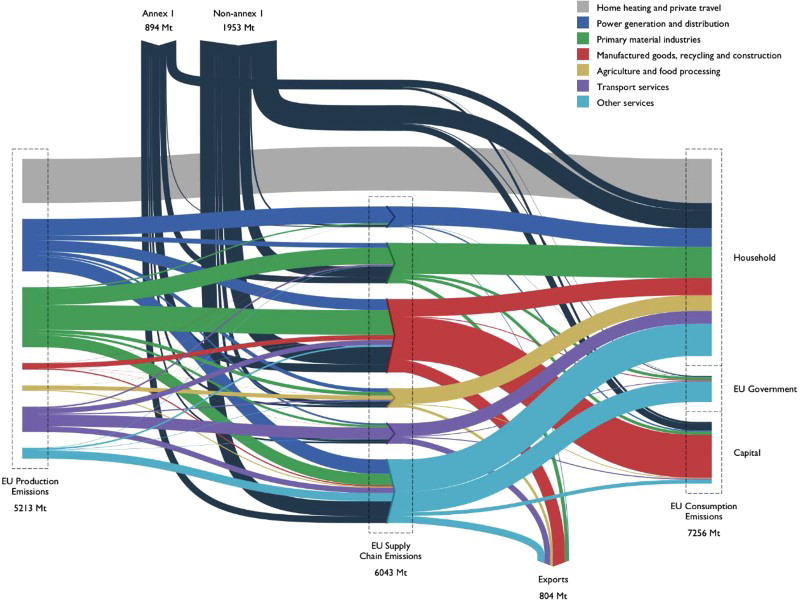
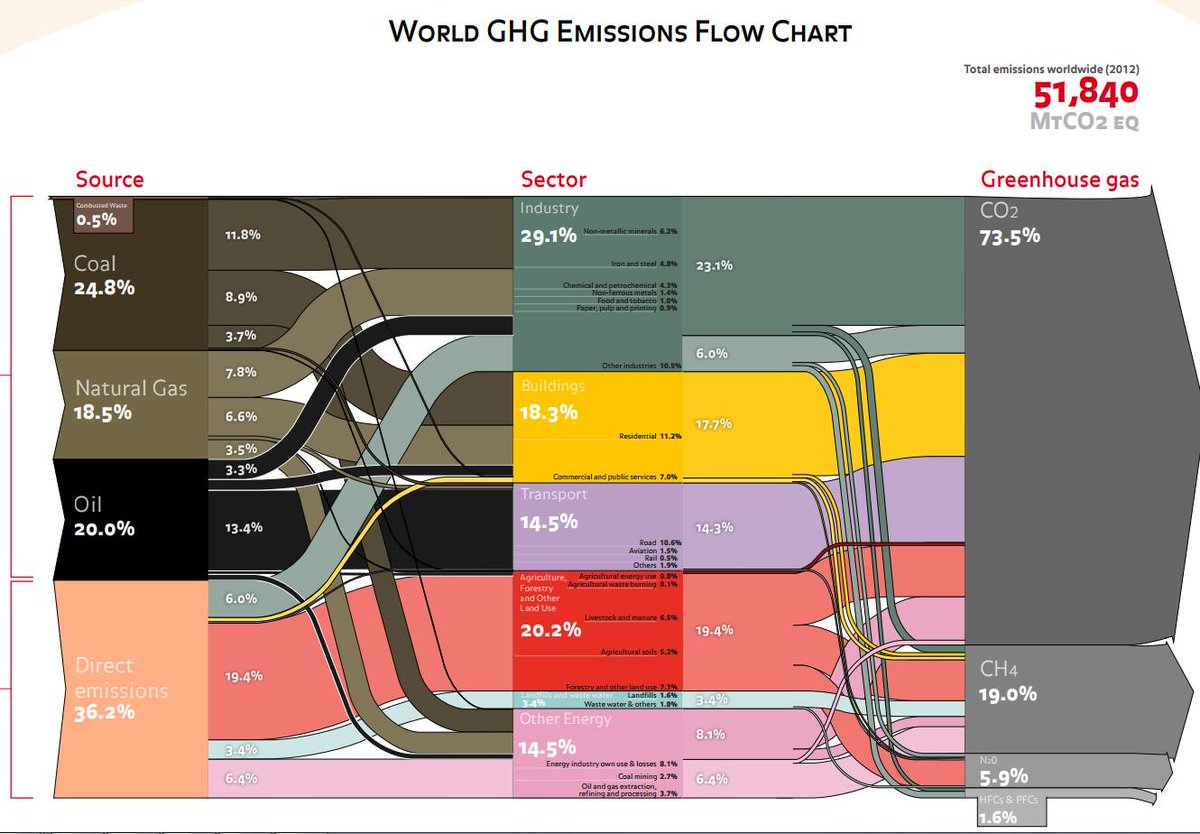
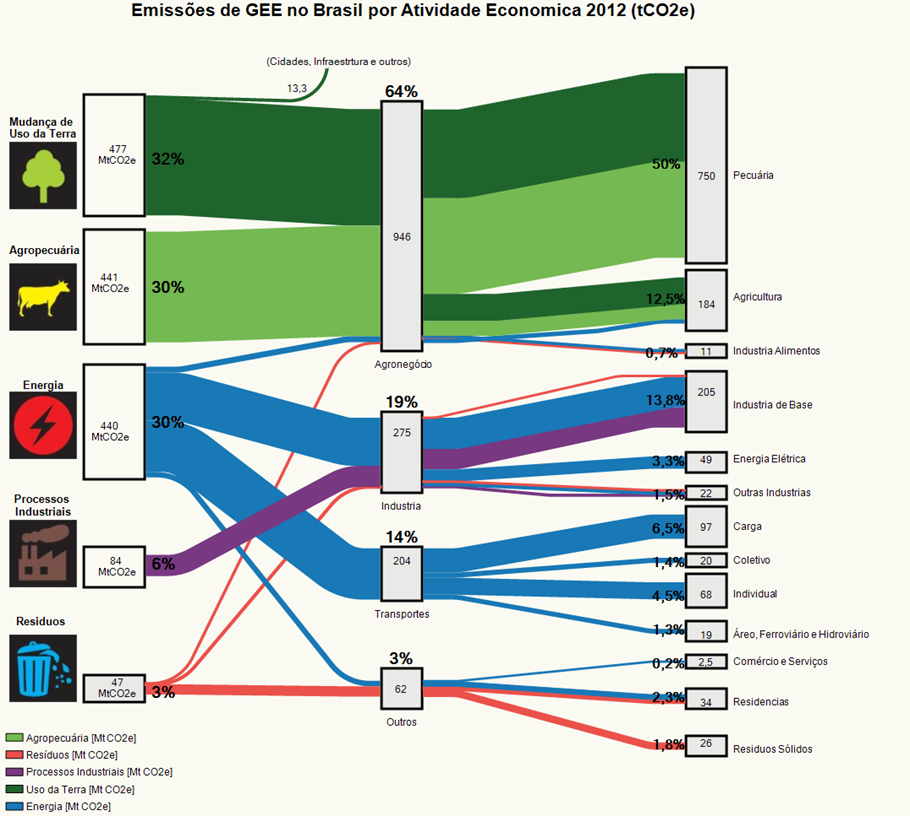
I was pointed to an article on carbon footprint, that used Sankey diagrams to underline a method of carbon accounting along the supply chain. This article was part of the “first virtual global conference on climate change” CLIMATE 2008 that took place, yes, exclusively on the Internet from November 3 to 7, 2008. (I must admit that this event passed largely unnoticed by me, although reading some of the papers now gives me the impression that it would have merited more attention.)

The paper titled “Carbon Accounting and Carbon Footprint - more than just diced results?” by Prof. Mario Schmidt from Pforzheim University describes the various approaches of corporate carbon accounting, carbon footprint of products, and Life Cycle Assessment LCA. Schmidt introduces a method that allows determining “cumulative emissions … at each point of the supply chain up to the POS”, and calls this the CO2 backpack.

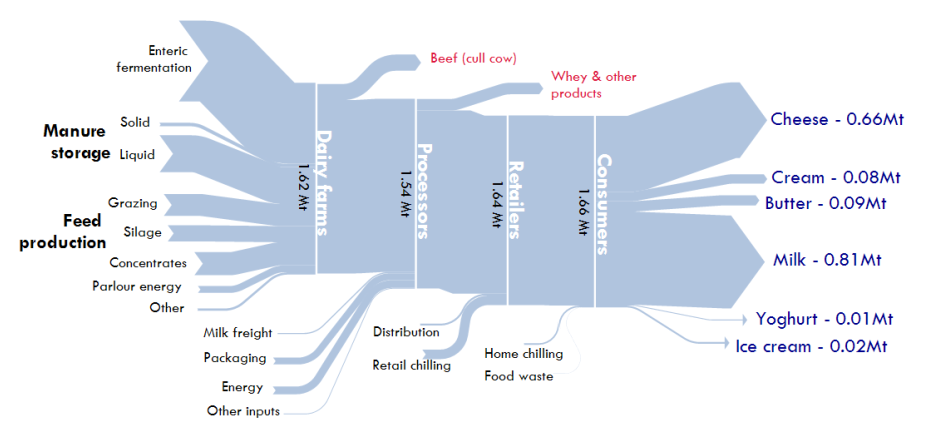
Sankey diagram of carbon emissions along a supply chain.  Source: Schmidt, M.: Carbon Accounting and carbon footprint – more than just diced results? Article submitted to CLIMATE 2008.  http://www.klima2008.net/index.php?a1=pap&cat=2&e=56 Reproduced witSankey diagram of carbon emissions along a supply chain.  Source: Schmidt, M.: Carbon Accounting and carbon footprint – more than just diced results? Article submitted to CLIMATE 2008.  http://www.klima2008.net/index.php?a1=pap&cat=2&e=56 Reproduced witSankey diagram of carbon emissions along a supply chain.  Source: Schmidt, M.: Carbon Accounting and carbon footprint – more than just diced results? Article submitted to CLIMATE 2008.  http://www.klima2008.net/index.php?a1=pap&cat=2&e=56 Reproduced witSankey diagram of carbon emissions along a supply chain.  Source: Schmidt, M.: Carbon Accounting and carbon footprint – more than just diced results? Article submitted to CLIMATE 2008.  http://www.klima2008.net/index.php?a1=pap&cat=2&e=56 Reproduced wit

The four Sankey diagrams above from the article illustrate the idea. They show (1) the CO2 equivalent emisisons along the supply chain, (2) the value added in a supply chain, (3) the relative CO2 emissions per value of product, and (4) the total emissions of the products along the supply chain with sectoral gate-to-gate, cradle-to-gate or crade-to-grave approaches.

This article is well worth reading, you should do so while it is still available online.
Schmidt is an acclaimed expert in Sankey diagrams and has also published on the history and methodology of Sankey diagrams.

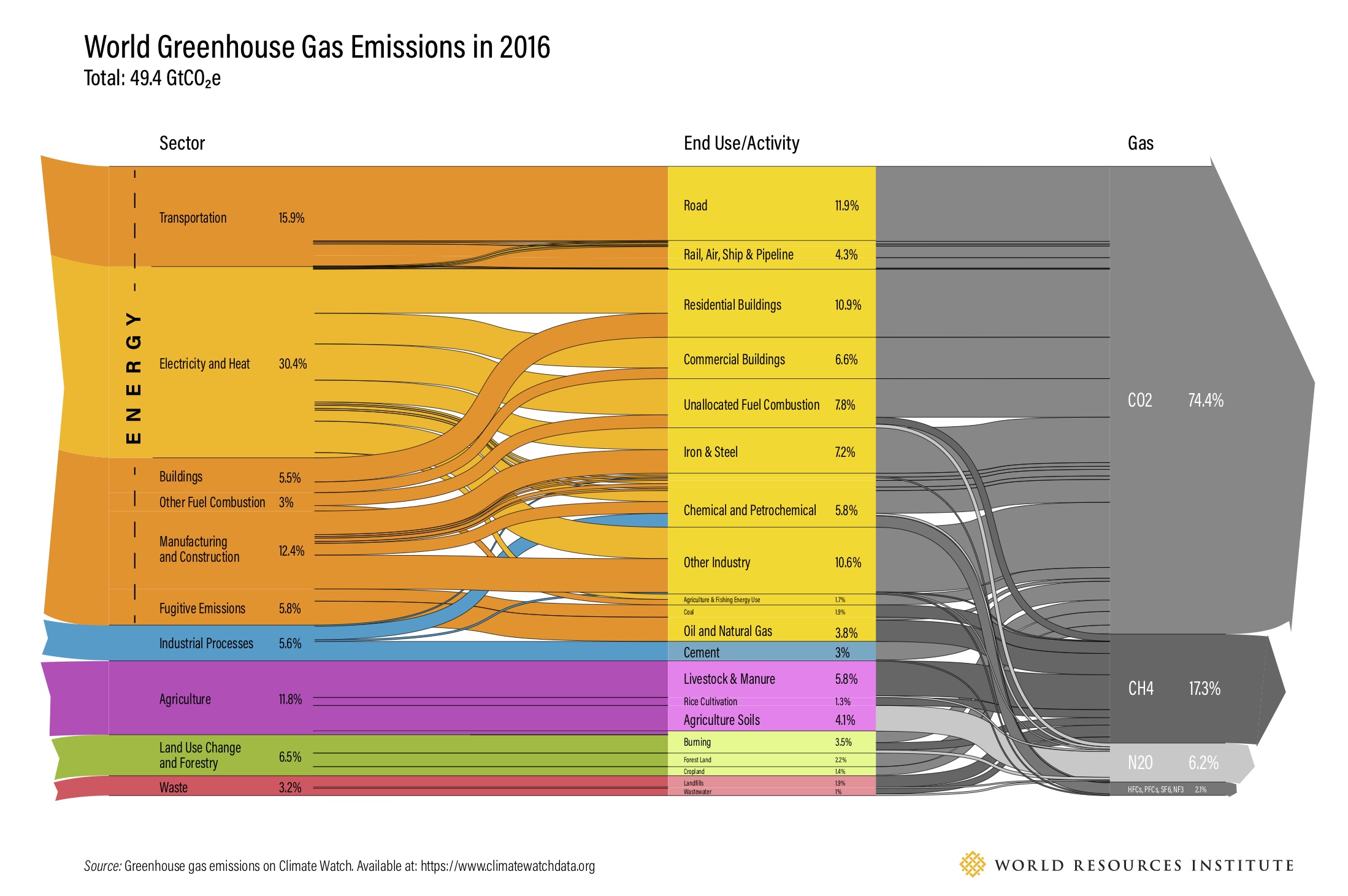
A great Sankey diagram is available in the Charts&Maps section on the website of the World Resources Institute (WRI), “an environmental think tank that goes beyond research”.

It shows the sectors from which greenhouse gases (GHGs) are released (such as energy generation, land use change, agriculture) and the end use areas or activities, through which CO2, methane and others gases are relased.

Data is for 2000, the diagram was published in 2005. A very well done Sankey diagram indeed, and highly educational.

Unfortunately a request for showing this Sankey diagram here on the blog was not granted by WRI, and an attempt to purchase the publication right (OK, it was not an attempt, it was a price inquiry only) was in vain.

I have to respect WRI’s copyright policies, so you have to click here to view the World GHG Sankey diagram, or download the large version PDF.

They also did a Sankey diagram on U.S. Greenhouse Gas Emissions, available on their website and as a PDF. Enjoy!

Bucknell University shows how it could reduce its GHG emissions significantly by switching over from a coal fired units to a cogeneration plant in 1998. The line-up is shown in a Sankey diagram.

Cogeneration Sankey (from Bucknell website)

Apart from the overall energy efficiency of 75% the Sankey diagram doesn’t show any figures. The shadow effects on the flows look funky, and add a spheric touch.

Doing a Google image search on ‘greenhouse effect’ brings up numerous versions of a diagram, that shows solar radiation partially being filtered by the atmosphere, partially hitting earth’s surface. This energy heats the earth, a part is being reflected as infrared radiation, where it is not able to escape fully due to greenhouse gas molecules from man-made emissions’ accumulated in the atmosphere.

Graphics from United Nations Environment Programme / GRID-Arendal

While some of these greenhouse effect diagrams use simple arrows, some of them show the energy levels with Sankey-like arrows.

Wikipedia has one of these as an illustration for the article on the greenhouse effect. Originally designed for Global Warming Art it is also available in the Wikimedia Commons in Finnish and in Japanese.

(Source: Wiki Commons)

Many of the “normal” diagrams are very appealing, and I especially like the one’s that target at kids or students. However, the diagram using Sankey arrows conveys more information. Check for yourself by comparing the two examples above.

The Energy Information Administration (EIA) of the U.S. Department of Energy (DOE) publishes an annual report on the Greenhouse Gas Emissions in the US economy. The executive summary of the 2005 report shows a Sankey diagram on page xv.

This Sankey diagram shows on the left side the different sources of CO2 (mainly combustibles), and on the right hand side the industrial sectors (residential, commercial, industrial and transport) that contribute to the CO2 release. Emissions are in million ton CO2-equivalents

The original Sankey diagram from the report has been reproduced with the e!Sankey software, and is shown below. Footnotes have been omitted, for full detail please refer to the original source.

GHG emissions for 2005 in the United States economy. The Sankey diagram shows the sources of CO2 as inputs on the left side and the sectors contributing to the release of CO2/Non-CO2 greenhouse gases as outputs. Diagram by El_Gordito